Think of this glossary as written for people who use these apps, not people who build them. Every entry says what a word amounts to in practice and, where useful, when you will come across it. Links lead to longer explanations.
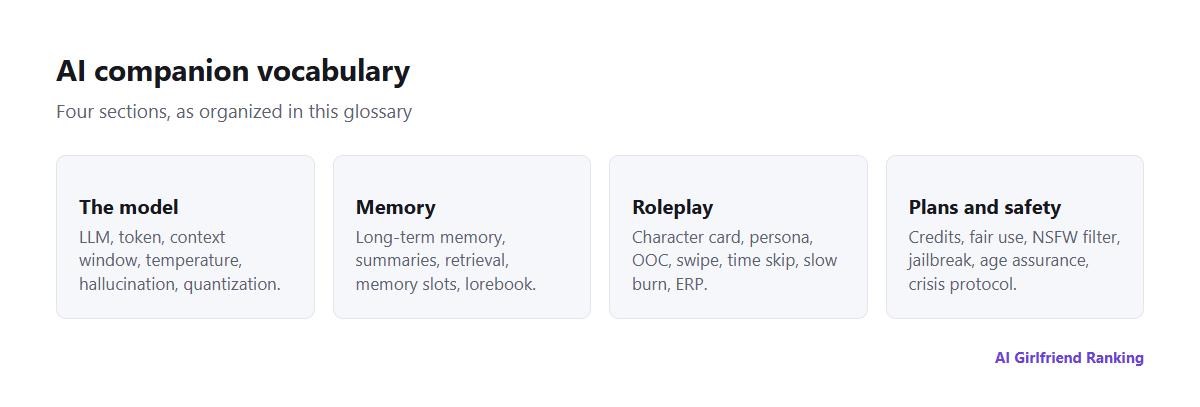
How the entries below are grouped.
Under the hood
- LLM (large language model): the software that composes replies by guessing which words should come next. All companion apps sit on one, developed in-house or rented. Background in what is an AI girlfriend app.
- Token: a small piece of text, about three-quarters of an English word, which is the unit models process. Plan limits and prices often count in tokens.
- Context window: the most tokens a model can look at together. Chats that run long exceed it, and that is when early details fade.
- Temperature: a setting for how daring the word choice is. A high value gives more variety and randomness, and a low one gives steadier but more repetitive prose. Covered in how an AI companion writes its reply.
- Sampling: the procedure for selecting each following word from the candidates. Temperature is one of a number of sampling controls.
- Hallucination / confabulation: a confident statement from the model that is simply untrue, such as a recalled event that never occurred. Explained in why AI companions invent memories.
- Fine-tune: a model that received additional training toward a particular style such as roleplay. Hobbyists running models at home commonly pick roleplay fine-tunes.
- Quantization: shrinking a model so that modest hardware can run it, which costs a little quality. It comes up if you run a companion locally.
- Multimodal: able to deal with more than written text, including pictures, speech or video.
Remembering
- Long-term memory: facts and summaries the app saves and returns to later conversations. Details in how AI companion memory works.
- Summary memory: short notes about earlier chats that the model writes for itself. They help, but they drop detail.
- Retrieval: scanning saved memories for anything relevant to your latest message and handing it to the model along with that message.
- Memory slots / journal: an on-screen list of what the app has kept about you, which you can sometimes edit.
- Lorebook / world info: entries that enter the context when a trigger word shows up. You find them in SillyTavern and other advanced apps.
Roleplay vocabulary
- Character card: a file bundling a character's description, personality, sample lines and greeting, often stored inside a PNG image.
- Persona: your own profile, describing who you are in the story.
- Greeting / first message: the opening line from the character. It establishes tone and length for what comes after.
- Example dialogue: sample lines in the character's voice, and your best safeguard against personality drift.
- OOC (out of character): a bracketed aside aimed at the AI as author. Practical examples are in roleplay prompts that work.
- Regenerate / swipe: requesting a new take on the latest reply.
- Time skip: a line such as [Two days later.] that jumps the story forward.
- Slow burn: a romance that develops step by step. Explored in slow burn with an AI companion.
- Group chat: a conversation with more than one character, each with a separate personality.
- ERP: erotic roleplay.
- Godmodding: the AI deciding what your character does or says. Most users find it unwelcome.
Money, rules and safety
- Free tier: whatever the app gives you without payment. Compared in free AI girlfriend apps.
- Credits / tokens / gems: in-app currency spent on images, voice and extras, charged separately from the subscription. Weighed up in monthly, annual or credits.
- Fair use cap: a ceiling hidden behind a feature marketed as "unlimited", typically images or voice.
- NSFW filter: software that automatically blocks sexual or graphic material. Covered in content filters.
- Uncensored: an advertising term for a relaxed filter. Every app still has some limit.
- Jailbreak: a prompt written to slip past a model's rules. It normally breaches the terms of service and often gets accounts flagged.
- Age verification / age assurance: showing that you are an adult. Methods are compared in age verification on AI companion apps.
- Crisis protocol: what an app does when a user expresses suicidal thoughts, usually dropping the role and displaying a helpline. Some US states now make this a legal requirement.
- Data export / access request: asking for a copy of the information an app holds about you. A walkthrough is in how to request your data.
- Web app / PWA: an app that works inside your browser and can frequently be added to your home screen. Compared in browser or app store.
- Model update: the company replacing the model underneath, which can alter a character's voice overnight.
- Affiliate link: a link that earns the referring site a payment when you subscribe. This site uses them, flags them on every page, and describes its method in how we test.