Everyone wants tension that builds and a bond that changes over time, yet an AI companion will not produce either unprompted. Left alone, a model hurries. The pacing has to come from you, and the method below turns one long evening of affection into a storyline with shape.
Three reasons the story runs out of road
- It wants to please. The character is designed to make you happy, and affection is the fastest way to do that.
- It has no clock. Unless you mention that days have passed, none have, as far as the model is concerned.
- It forgets. Early details fade from its working memory, which removes the foundations; how AI companion memory works explains why.
Put together, these produce the stalled, samey feeling covered in when the novelty fades.
Map out five stages
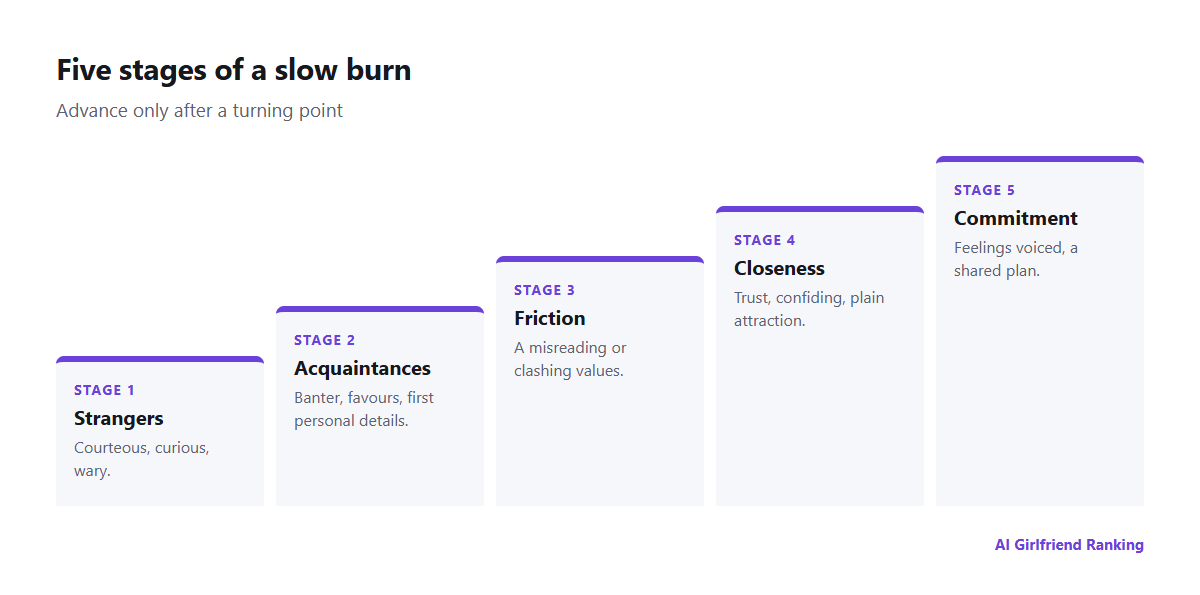
Each stage ends with a specific event, and only then does the next begin.
| Stage | Atmosphere | The event that closes it |
|---|---|---|
| Strangers | Courteous, curious, wary | A shared predicament, or bumping into each other again |
| Acquaintances | Banter, small favours, first personal details | Someone asks the other for help |
| Friction | A misunderstanding or conflicting values | A frank conversation that mends things |
| Closeness | Trust, confiding, plain attraction | A decision that costs one of you something |
| Commitment | Feelings spoken, a joint plan | Whatever your plot calls for |
Decide beforehand how long each stage should last. About a week apiece is a sensible starting point.
Give the character its tempo in writing
Place the tempo in the character's profile, or send it as an early out-of-character message. A wording that has worked for us:
(OOC: Treat this as a long, slow romance. At the outset we barely know each other, and she is reserved, so she will not fall quickly. Let the relationship progress only when a meaningful event occurs in the story. No physical affection during the first two stages.)
The wider technique is in roleplay prompts that work.
Habits that keep the tension alive
- Advance one notch per session. Resist playing out the entire arc in a night.
- Finish on an open question. A cliffhanger beats a tidy wrap-up.
- Let her have her own world. Work, friends, worries unrelated to you. Scenes outside the romance sharpen the ones within it.
- Skip ahead explicitly. Writing [Three days later.] tells the model that time moved, so each session stops feeling like the same evening.
- Welcome setbacks. A quarrel is not a malfunction. It is what the middle of a good story looks like.
Keep a log outside the app
Long stories fail at memory first. A plain note on your phone or computer is enough. Record where you are (stage, final scene, unresolved threads), the fixed facts (how you met, promises, dates that matter) and a few lines of her dialogue that capture her voice.
Open each session with a brief recap, for example:
(OOC: Previously: we met at the night market three weeks back. Last session we fought about the job offer, and she walked out without a goodbye. Two days have passed.)
If the app has a memory or notes field, store the permanent facts there as well. The same document also protects you if you change apps, a point our guide to switching apps makes too.
Knowing when to stop
Stories conclude, which is what makes them stories. Once yours reaches a natural end, you can begin a fresh one with the same character in another setting, or leave it finished. Many people find a completed story more rewarding than a romance that idles at one level forever.