A single companion can seem flat in one chat and lively in the next, and the cause is usually the first couple of messages you send. Those messages are the subject here.
Why the first message matters
A language model guesses what text should come next, using all the text already in the conversation. The mechanics are covered in how an AI companion writes its reply. Three habits follow from that.
- It echoes how much you write. One line gets a brief answer; a full paragraph gets one back.
- It echoes how you write. Use present tense and small physical details, and you will get the same. Type "hey wanna rp" and you will get something equally casual.
- It fills any gap with the most typical choice. Leave out the place and the time, and the model falls back on the most common setting it has seen, hence all those coffee-shop meetings.
So you do not need a secret phrase. You need to supply enough story for the model to extend.
Four building blocks
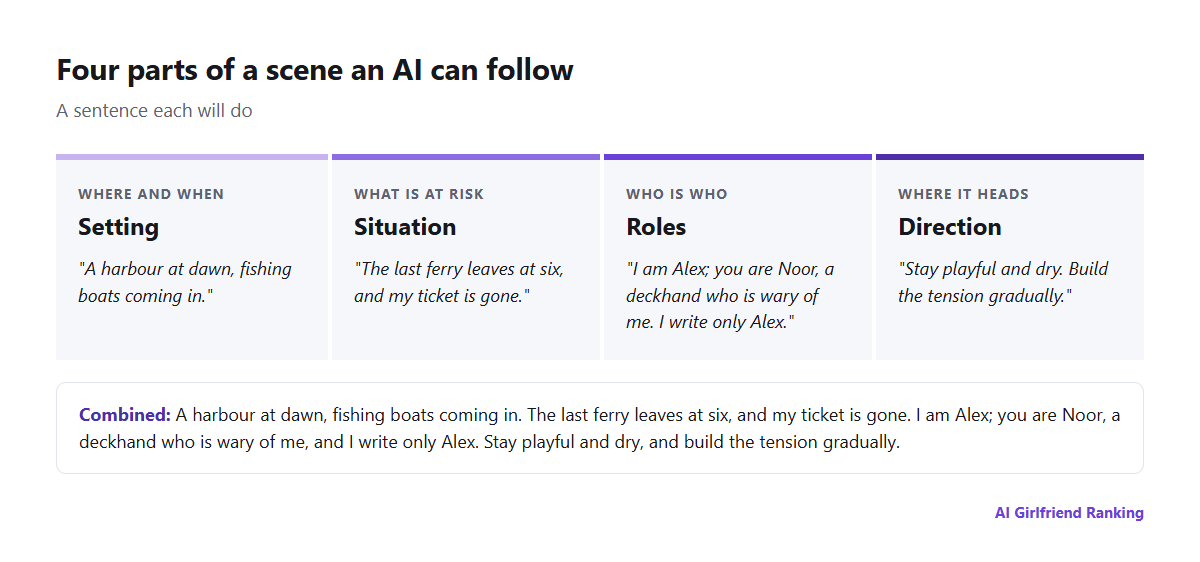
Every scene that a model can pick up has these four blocks, and a single sentence for each is enough.
Setting. Name the place and time, with one or two specifics. Instead of "a city", write "a night market in the rain, stalls packing up".
Situation. Say what has just occurred or what hangs in the balance. Without a reason to exist, a scene drifts.
Roles. Spell out who you are, who the character is here and what each of you knows. This is also the place to state that you write only your own part.
Direction. Say where you want it to go: the mood, the speed, the likely destination and any boundaries.
Side-by-side openers
| Flat | Stronger |
|---|---|
| "Let's go on a date." | "A Friday evening at the small Italian restaurant you picked for its calm. It is not calm: a birthday party has taken over the next table. I walk in ten minutes late, dripping wet. Sorry, my bus broke down. You look lovely, by the way." |
| "Be my girlfriend on a trip." | "We are three days into a drive up the coast. The air conditioning failed an hour back, and we have been half-jokingly arguing over who proposed this. I swing into a gas station. You speak for yourself, I speak only for me. Stay light and playful." |
| "Fantasy roleplay please." | "A frontier town the night before a festival. You are the healer who patched me up this morning, and I am a courier who cannot afford to pay. You are still deciding whether I can be trusted. Let the tension simmer across several scenes." |
The longer versions are not padded. Each one settles the four blocks, and each finishes on something the character can react to.
Nudging a scene that is under way
Out-of-character asides. Nearly every model treats a short bracketed note as a message for the author and not the character: (OOC: ease off the description and give me more dialogue.) Keep it to a line and place it after your turn.
Jumping ahead. A line such as [Two hours later, back at the apartment.] gets a stuck scene moving more dependably than asking the character to bring up something new.
Regenerate or rewrite. If a reply goes astray, regenerate or edit it in place rather than debating it in the chat. Whatever stays in the history turns into an example the model will follow.
Describe the wanted behaviour, not the unwanted. "She replies in short, dry sentences" generally beats "stop rambling". Naming what you dislike puts it into the very text the model is extending.
One request per message. Ten rules at once get averaged into nothing. Deal with the biggest problem first, then the next one.
Keeping a lengthy scene coherent
A long roleplay eventually runs past what the model can reread on each turn, so early details slip away. How AI companion memory works explains the same limit. Two habits make up for it.
- Post a recap from time to time. Three OOC lines stating the location, the events so far and the points that matter put the essentials back in front of the model.
- Use the memory or notes field for anything that must stay fixed: names, relationships, injuries, promises.
If the character still contradicts itself, it is not brushing you off. It made up a detail to cover a gap, which why AI companions make up memories describes. Fix it in a line and continue.
The character profile's role
Scene prompts sit on the character's lasting description. A flaw that turns up in every scene, such as stiffness, overeagerness or the same pet name each time, belongs in the profile and should be corrected there. Our guide to character builders lists the fields that count.
Should a scene break off with a refusal, blame the app's filter and not your wording. Content filters sets out what each type does and why even permissive apps keep a minimum.