Age checks have come in two waves. The first targeted pornography sites. The second reached AI chatbots that can generate sexual material or play the part of a companion, and companion apps are now caught up in both.
The rules driving the change
Canada. No federal law currently forces these apps to verify age. Two bills are worth watching. Bill S-209, the Protecting Young Persons from Exposure to Pornography Act, would require age verification or age estimation from commercial providers of pornographic material. It cleared the Senate in April 2026 and was at second reading in the House of Commons in late September 2026, so it is not law. Bill C-34, the Safe Social Media Act, was tabled on 10 June 2026. It would set a minimum age of 16 for social media and give AI chatbot services a duty to act responsibly toward children, overseen by a new Digital Safety Commission. It has not passed either. Until one of them does, the checks Canadians meet mostly come from foreign rules or a company's own policy.
United Kingdom. Under the Online Safety Act, services hosting pornography had to put "highly effective age assurance" in place by 25 July 2025. Ofcom had warned providers in 2024 that generative AI chatbots capable of producing pornographic content are covered. In 2026 it opened investigations into AI services, one of them a companion chatbot provider, over how they check age. Penalties can reach £18 million or 10% of worldwide revenue.
United States. The Supreme Court ruled in June 2025 that a Texas law requiring age verification on sites with a large share of sexual content was valid (Free Speech Coalition v. Paxton). That opened the door to similar state laws. Separate companion chatbot laws in California and other states add protections for users known to be minors, which gives apps a reason to learn who their users are. See AI companion laws in the US for the state-by-state detail.
The platforms themselves. Character.AI ended open-ended chat for under-18s in November 2025, using behavioural age estimation, third-party checks and ID as a last resort. OpenAI started rolling out age prediction in ChatGPT in early 2026.
Comparing the methods
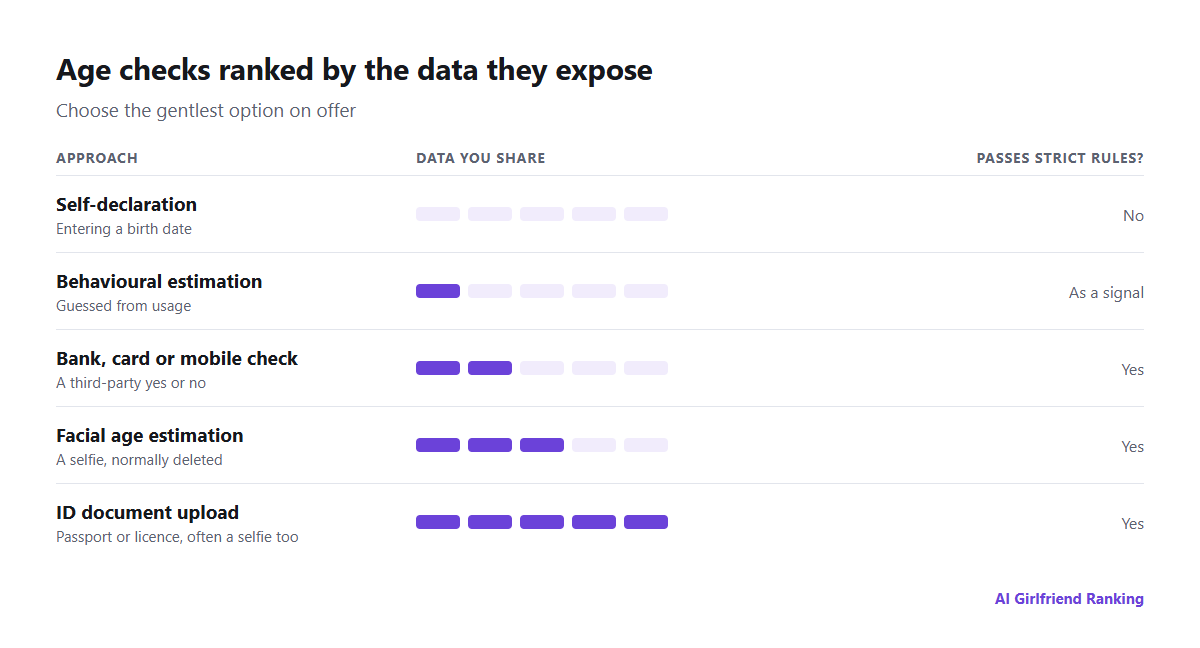
Ordered, roughly, from least to most data shared.
| Approach | What happens | What you give up |
|---|---|---|
| Ticking a box or typing a birth date | You state your own age | Nothing that can be checked, so it no longer passes in regulated markets |
| Behavioural estimation | The app guesses your age from how you use it | Usage data it already holds |
| Facial age estimation | Software judges your apparent age from a selfie | A face image, which reputable providers normally delete afterwards |
| Bank, card or carrier check | Your bank or mobile provider vouches that you are an adult | A simple yes or no from a third party |
| ID document | A photo of a passport or licence, frequently with a selfie | The most sensitive information of the lot |
| Digital ID or age token | A reusable credential that says "over 18" | Only the age claim, in the better designs |
Passing a check with minimal exposure
- Take the gentlest route on offer. When facial estimation or a bank check is listed beside ID upload, ID is seldom the smarter pick.
- Look for a named specialist. A dedicated verification company with a published retention policy is a safer holder of your data than an app keeping your passport photo in its own systems. The incidents described in AI companion data breaches show why that matters.
- Find the retention wording. "Deleted immediately after verification" is the phrase to hope for.
- Keep your real name out of the account email where you can. A check proves an age; it should not tie your identity to your chat history.
- If an app holds your documents, you can ask it what it has kept. Private-sector organizations covered by PIPEDA must generally answer access requests, and you can complain to the Office of the Privacy Commissioner of Canada if the answer is unsatisfactory.
What changes in daily use
- Expect extra prompts, especially from UK-facing apps, in US states with age laws, and whenever you switch adult content on.
- Features can vary by country. Some apps disable NSFW content in places where they have not built the checks, rather than build them. See why AI companion apps are blocked or limited in some countries.
- Shared devices need care. An adult account left signed in on a device a child uses undermines the whole system. See using an AI companion on a shared device.
Where this is going
Proving age is turning into a standard requirement for any service that leans towards adult material. The argument has moved on from whether to check to how to do it without creating fresh privacy problems. Reusable age tokens, which confirm "over 18" without revealing who you are, look like the best answer. Until they are widespread, the advice stays simple: choose the least invasive method on offer, and favour apps that rely on specialist verifiers over ones that collect documents themselves.