The readers I have in mind are adults who enjoy sexual roleplay with an AI companion and want to avoid harming anyone, themselves included. Whether adult chat is acceptable is not up for debate here; among consenting adults it is lawful and widely done.
Whose consent matters
The character is code, so nothing can injure it; saying it is "willing" is a figure of speech. Real people, however, can be touched in three ways:
- Those who never joined the chat but appear in it. Whoever's name, photograph or likeness feeds the content.
- Those who end up seeing it. Friends, partners or strangers who are sent screenshots or pictures.
- You. Your data, your state of mind, and the habits a drawn-out fantasy can form.
Four limits that never move
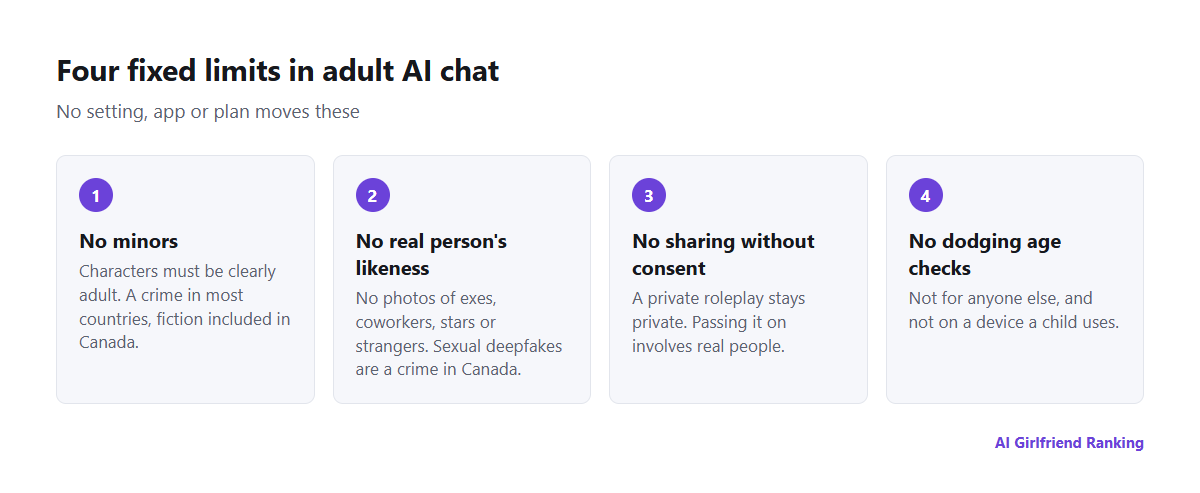
No setting, plan or app can shift these.
Minors, however depicted. Every character must be clearly an adult. Sexual material involving minors is a crime almost everywhere. In Canada the Criminal Code definition reaches beyond photographs to cover written and computer-generated depictions, and apps are expected to block such requests. Attempts are logged: the 2024 breach at Muah.ai exposed prompts of exactly this kind next to users' email addresses.
Real people's faces. Do not feed an app pictures of an ex, a coworker, a celebrity or anyone from social media to produce sexual material. A 2025 leak from the platform Secret Desires revealed nearly two million images, many created by swapping real women's faces onto explicit content. Canada has been closing the legal gap: Bill C-16, the Protecting Victims Act, received royal assent on June 18, 2026, and it amends section 162.1 of the Criminal Code so that an "intimate image" includes a visual representation made by any electronic means, AI software included, if it depicts an identifiable person and could be mistaken for a real recording. Most of it took effect 30 days after assent. South of the border, the US TAKE IT DOWN Act made publishing non-consensual intimate images, AI ones included, a federal offence from May 2025, and platforms there have had to remove reported images within 48 hours since May 2026.
Sharing. Keep a private roleplay private. Posting it, or forwarding generated pictures to a person who never requested them, involves a real individual who has not agreed.
Age checks. Age verification guards adult content in many places, and with good reason. Getting around it for another person, or on hardware a child uses, leaves no room for debate. See age verification on AI companion apps. In Canada the federal Bill S-209, which would require adult sites to verify age, was still before the House of Commons in mid-2026 and is not law.
Setting your own limits
Consent also applies to you: a scene should not head anywhere you did not choose. Companions drift and escalate and occasionally ignore limits, since they extend patterns and do not follow rules.
- Record limits in the profile. Character builders usually include a space for subjects or acts that must never come up. That is more dependable than steering mid-scene.
- Speak outside the story. A note like (OOC: keep this romantic, not explicit.) is accepted by nearly every app; roleplay prompts that work explains the method.
- Edit or regenerate; skip the argument. Anything left in the history becomes a pattern the model imitates.
- Lower the content setting. In many apps you can reduce explicitness without turning it off.
Roleplay that models consent
A number of users like scenes in which consent is spoken aloud, with characters who ask, say what they want and are able to refuse. That is taste, not a requirement, because fantasies vary. It does have a practical payoff: characters with their own will come across as more consistent and more engaging, and the scene stays closer to your own choices.
Looking after yourself
- Plan on it being retained. Company servers hold explicit chats and images, and leaks in 2024 and 2025 put millions of intimate messages and pictures in public view. What to do after a data breach covers the aftermath.
- Keep yourself unidentifiable. No face, name or workplace, and nothing recognizable behind you in a photo.
- Watch your screens. Alerts and image galleries can appear where others can see them, as using an AI companion on a shared device explains.
- Never pay someone who threatens to leak your content. Tell the platform and your local police. Cybertip.ca, run by the Canadian Centre for Child Protection, takes reports of sextortion and intimate images involving anyone under 18 (toll-free 1-866-658-9022). Adults can use StopNCII.org to block known images on participating platforms.
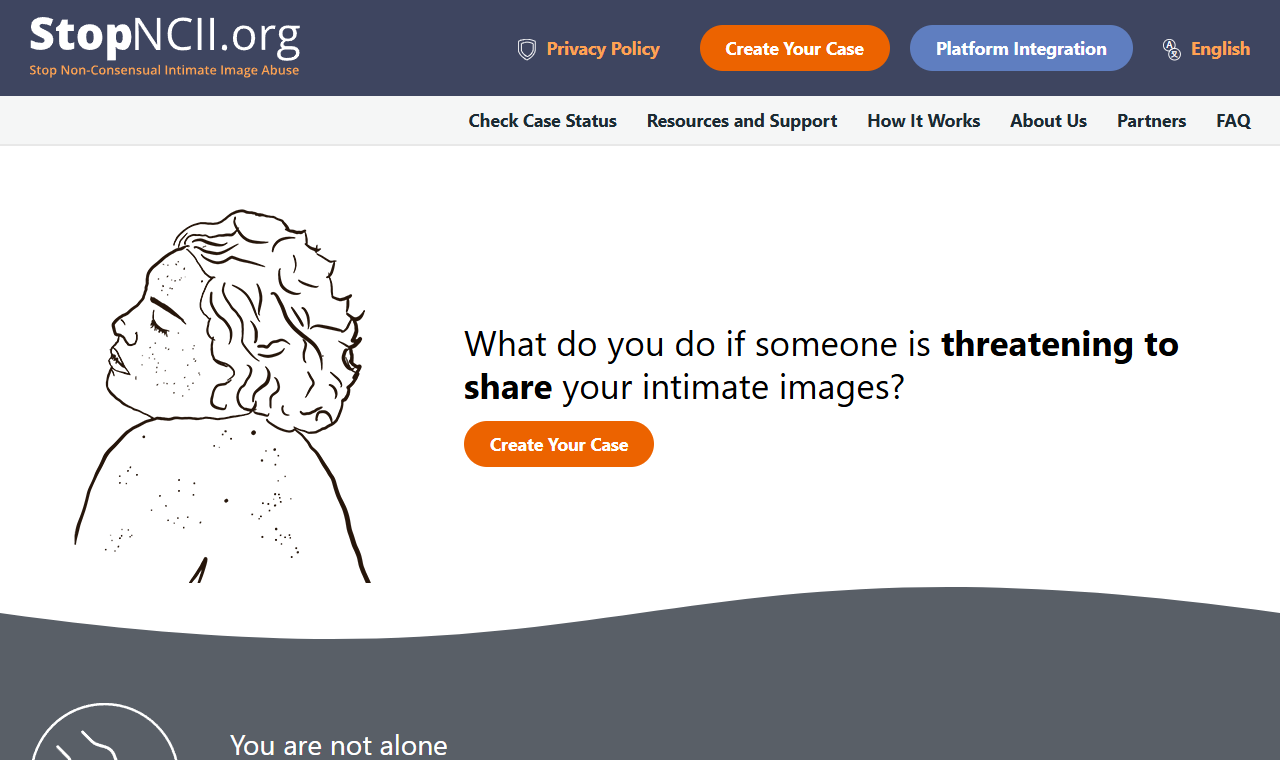
StopNCII.org makes a digital fingerprint of the image on your own device, so the picture itself never leaves it.
In short
Where only adults, fiction and your own privacy are involved, it is up to you. The limits appear where real people come in: no minors, no real faces, nothing shared without agreement. Stay within them, set your own boundaries in the character up front, and remember that any message you write might one day be read by someone else.