You can see the change most clearly in what customers are buying. Conventional adult entertainment sells something to watch. A lot of AI companion apps sell something nearer to a relationship, with a character who answers, recalls details and adjusts to you. That alters the product, the economics and the risks.
The shifts AI brings
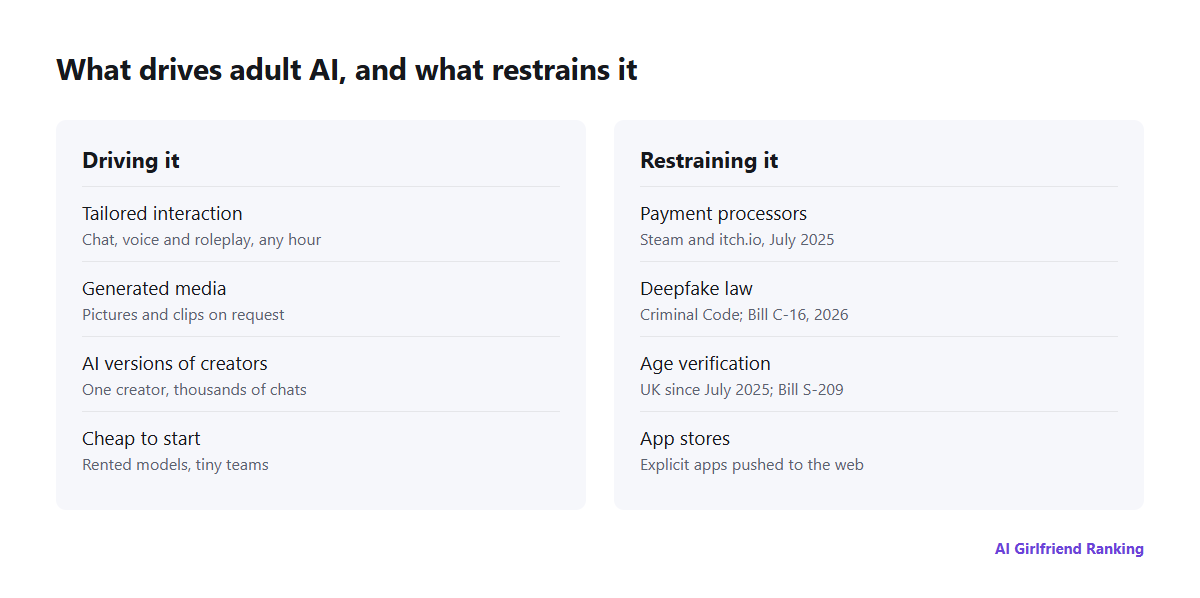
The pressures that propel adult AI, and the ones that restrain it.
- Taking part rather than watching. Chat, voice and roleplay built around one person, available at any hour.
- Pictures on request. Images and brief clips of characters who were never real. What limits them is price and consistency; the breakdown is in what image generation really costs.
- AI versions of real creators. With permission, a creator can "speak" with thousands of fans at the same time. CarynAI was the first well-known case, and it also demonstrated how fast things can unravel. See AI clones of real people.
- A low barrier for small teams. Anyone able to rent a model can release a companion product, which accounts for the sheer number of them.
The forces holding it back
Payment processors
Card networks and payment firms write adult-content rules that follow them into every country they serve. In July 2025, following a campaign aimed at payment providers, Steam pulled hundreds of adult games and itch.io hid its adult listings, each pointing to payment partners. Companion apps depend on those same networks, so a feature or a way of paying can vanish in a single day.
Deepfake and intimate-image law
The gravest harm here is sexual imagery of real people produced without their consent. In Canada, sharing intimate images without consent has been a Criminal Code offence for years (section 162.1). Bill C-16, the Protecting Victims Act, received royal assent in June 2026 and extends the definition of an intimate image to include realistic AI-generated deepfakes, with a higher maximum penalty. Another country's example points the same way: the US TAKE IT DOWN Act, signed in May 2025, criminalized publishing such images, including AI-made ones, and obliges platforms to remove reported images within 48 hours from May 2026. The 2025 leak at Secret Desires, which exposed face-swapped explicit images of real women, shows what these laws are responding to.
Age verification
The UK has demanded effective age checks from pornographic services, AI tools that produce such material included, since July 2025, and the US Supreme Court upheld state age-verification laws that same summer. Canada has no such statute yet. Bill S-209, which would penalize commercial pornography providers that skip effective age verification or estimation, cleared the Senate in April 2026 and was awaiting second reading in the House of Commons when I last checked. Apps serving a global audience already verify ages or disable features by country; see age verification on AI companion apps.
App stores
Apple and Google limit sexual content, so most explicit companions run on the web rather than in a store. The details are in browser or app store.
How companies respond
| The pressure | What operators tend to do |
|---|---|
| Payment processor policies | Use separate billing entities, choose billing descriptors carefully, change payment options |
| App store limits | Launch on the web first, offer a toned-down store edition |
| Age-verification rules | Bring in outside age checks, or disable adult features in certain countries |
| Deepfake legislation | Prohibit real-face uploads, drop face-swap tools |
| Brand risk | Keep adult features away from the mainstream brand |
These responses account for several things you may notice yourself: a card statement showing a name unlike the app's (see payment privacy), a feature that works in one country but not another (see blocked or limited countries), and permitted content that suddenly shifts.
What this means if you use these apps
- Plan for change. Adult features are the likeliest to be altered or withdrawn, so skip long prepaid plans.
- Guard your identity. Adult data does the most harm when it leaks. Use a separate email address and leave your face out of it; see AI companion data breaches.
- Respect the fixed limits. No minors, no real person's likeness, nothing shared without consent. These are set out in consent in NSFW AI chat.
- Favour operators that follow the rules. Age checks, bans on real faces and plain billing suggest a company intending to still exist next year.
AI is making adult entertainment more personal than before, and subjecting it to more gatekeepers than before. The apps that endure will be those that deliver the former while accepting the latter.