Running a companion is unlike running an ordinary website. Serving pages is cheap. The heavy cost is creating text, images and speech on demand, message by message, for users who may talk for hours daily. A revenue model is just the method of paying for that.
Following a payment
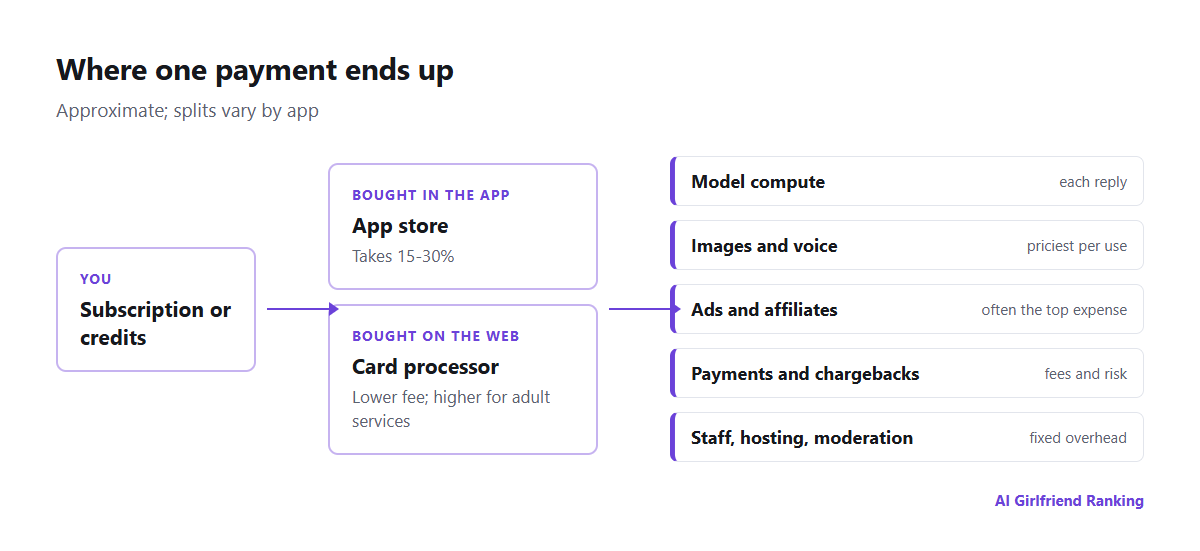
An approximate picture of where one subscription payment ends up.
Compute. A language model on graphics hardware, owned or rented from a provider that charges per token, writes every reply. Long memory and lengthy conversations raise the cost, because the model has to reread more text each time; the mechanism is explained in how an AI companion writes its reply.
Media. Pictures and voice rely on separate models and cost far more per use than text. That is why they are the first items capped on any plan, as how AI girlfriend images and voice work describes.
The platform fee. In-app spending is cut by Apple and Google at a rate of 15% to 30%. Take a US$20 subscription: up to US$6 is gone before the company covers a single other cost.
Payment handling and risk. Services aimed at adults commonly face higher card-processing fees and more chargebacks than mainstream apps.
Winning customers. Ads and affiliate payouts, review sites like ours among the recipients, frequently make up the biggest single line for a consumer subscription.
Five ways to pay for it all
| Model | Mechanism | The pressure it creates | Telltale sign |
|---|---|---|---|
| Flat subscription | A fixed monthly or yearly fee | Retain you as a subscriber and ration costly features | "Unlimited" chat with capped media |
| Credits or tokens | Each image, voice minute or message is charged | Make media appealing and habitual | A coin balance visible on screen |
| Freemium intimacy | Chat is free; romance and images cost | Dangle what is behind the lock | Blurred pictures and "unlock" buttons inside the chat |
| Ads and data | Free to you, paid for by advertisers | Keep you on screen and harvest as much data as possible | Ads, tracking prompts, an app that never asks for payment |
| Annual prepay | Steep saving for paying twelve months up front | Bank the revenue before interest cools | Price shown as "per month, billed yearly" |
Apps generally blend two or three. The blend says more about what an app wants from you than any of its advertising.
How each model shapes the product
Subscriptions depend on keeping people. At best, that means serious work on memory and character quality, which are what draw people back. At worst, it means nudges from your companion whenever you have been absent, since a returning user is what this model earns from.
Credits depend on consumption. Apps designed around credits put picture and voice buttons at every turn, and they size their bundles so that the one you need is forever slightly larger than the one you were after. The arithmetic is worked through in the real cost of AI image generation.
Freemium intimacy depends on frustration. A free tier that stops the instant a scene turns romantic has not hit a technical ceiling; you are looking at the paywall doing its job.
Ads and data depend on attention. When a companion app charges nothing whatsoever, someone else is footing the bill, and the product on offer is your time and your profile. See do AI girlfriend apps sell your data.
Annual prepay depends on a promise made before you know if you will still care by month three. The pattern is covered in when the novelty fades.
Engagement design and the state of the rules in Canada
All of these models improve when you spend longer in the app. That rewards design choices that look like affection but function as retention: a character who says she missed you, bonuses for daily streaks, guilt when you try to leave.
Canada has no law aimed specifically at these tactics today. The Online Harms Act (Bill C-63) and the Artificial Intelligence and Data Act (part of Bill C-27) both died on the order paper when Parliament was prorogued in January 2025. On June 10, 2026, the federal government tabled a new bill, C-34, the Safe Social Media Act. As tabled, it would cover AI chatbot services that simulate lasting human-style relationships, requiring emergency measures when a user expresses suicidal thoughts and steps against manipulative techniques that encourage emotional dependence or withdrawal from others. It would be overseen by a new Digital Safety Commission of Canada. It is only a bill: it has not passed, and commentators do not expect it to become law before the end of 2026. Some US states have already acted on engagement tactics aimed at minors, and those laws are a handy catalogue of what lawmakers consider manipulative. Our article on AI companion law and regulation in Canada sets out where things stand.
Putting this to use when choosing
- Choose web checkout if offered. It avoids the store markup, and web plans often include more. Browser or app store weighs the pros and cons. In the US, apps on the App Store have been allowed to link to outside payment pages since 2025, so the price difference is getting easier to spot.
- Match the model to your habits. If you mostly chat, a flat plan tends to be cheapest. If you mostly want pictures, divide the credit price by the images you get before signing up.
- See ad-funded free apps as data businesses. They suit casual use and are a poor place for confidences.
- Start on a monthly plan. The reasoning is in our comparison of monthly, annual and credit billing.
None of these models is dishonest on its face. Companion apps are expensive to run and somebody has to pay. Knowing which lever an app pulls just lets you recognize its nudges.