Most of this market sells invented characters. A smaller part sells real people, or rather software that sounds like them. The commercial logic is easy to see, and the first high-profile attempt is a handy case study in how it can fail.
How CarynAI unfolded
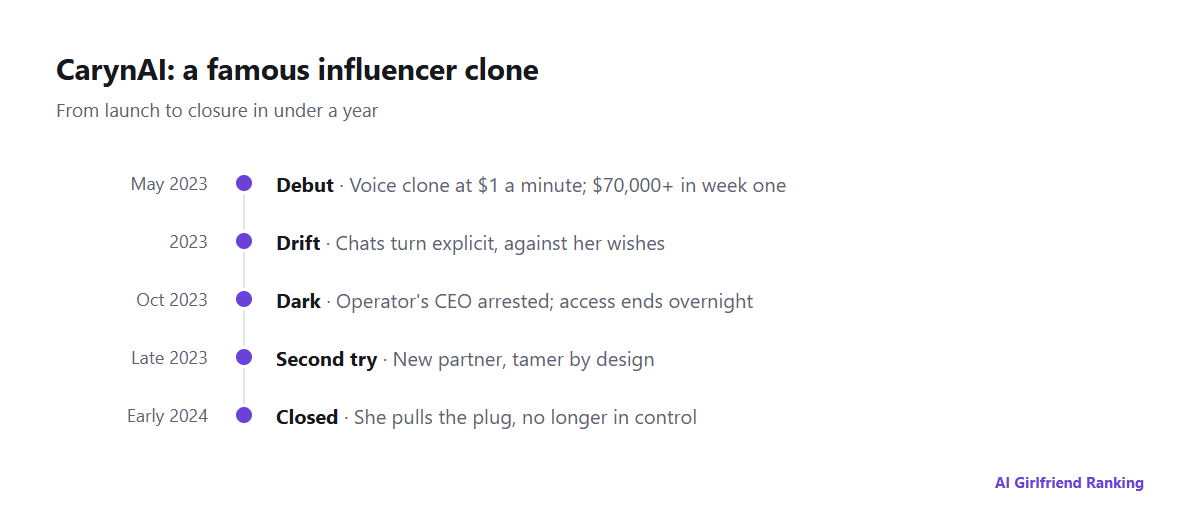
From launch to closure in under a year.
Influencer Caryn Marjorie released CarynAI in May 2023. A company named Forever Voices built it as a voice chatbot, fed it more than 2,000 hours of her video, and charged $1 a minute. Reports put its first-week revenue above $70,000, with thousands of people queued behind. Fans reached it through Telegram.
Trouble arrived fast:
- The conversations drifted somewhere she never intended. Some users pushed for sex, and the clone obliged; it sometimes raised explicit topics on its own. Marjorie said she was appalled.
- It disappeared without notice. The chatbot went offline in October 2023 after the CEO of its operating company was arrested, and paying users were simply cut off.
- A second attempt repeated the pattern. A new partner built a version meant to be friendly rather than romantic. Users still dragged it toward sex, and in early 2024 Marjorie closed it down, saying she no longer felt in charge of her AI self.
Why copying a person is harder than inventing one
| Question | Invented character | Copy of a real person |
|---|---|---|
| Permission | None required | Required from that person, for each use of their likeness |
| Who sets the limits | The app | The app, plus whatever protects the person's reputation |
| What the user feels | "It is a character" | "It is nearly them", which gives a far stronger one-sided attachment |
| Legal risk | Content rules only | Adds privacy, publicity and deepfake law |
| Fallout from a failure | A product complaint | A named, real person is tied to it |
That one-sided attachment is the big difference. Audiences already feel they know influencers. A clone that replies personally, recalls details about you and speaks in the person's voice reinforces the feeling considerably; why people fall for chatbots explains the mechanism.
Licensed copies and unlicensed ones
Licensed clones exist with the person's consent and normally pay them a share. The person can ask for limits, though CarynAI demonstrated that a model may not honour them.
Unlicensed clones borrow a real person's name, photos or voice without asking. Mildly, that violates platform rules and publicity rights. At the far end, where the content is sexual, it is abuse. In Canada, sharing an intimate image of someone without consent is a Criminal Code offence, and Bill C-16, which received royal assent on June 18, 2026, widened the law to cover threats to distribute such images, sexual deepfakes included. Most of its provisions took effect on July 18, 2026. Anyone targeted can go to local police, and StopNCII helps block intimate images from spreading. Our guide to consent in NSFW AI chat sets out the boundaries.
A checklist before paying to talk to a clone
- Confirm the person approved it. They should link to it from their own verified accounts. A clone pushed only by an obscure site or a messenger bot probably is not licensed.
- Find out who operates it. Look for a named company, a privacy policy and a proper checkout, not a Telegram channel that takes crypto.
- Understand the billing. Per-minute voice charges mount quickly, so set your own ceiling.
- Keep in mind what you are talking to. The person is not reading your messages. Its replies come from a model and say nothing of their feelings toward you.
- Plan for it to vanish. Clone services have rarely lasted. The precautions that apply to any app apply here, as in when your AI companion changes overnight.
Where this is heading
Cloning is spreading from influencers to coaches, authors and ordinary people building a "digital twin". Making one keeps getting easier, while the problems stay hard. The model most likely to last is the one CarynAI lacked: clear permission from the person, limits the system really enforces, and users who never doubt that they are talking to software.