Long-time users of AI companions have likely seen a small version of this. An update lands and the character seems slightly off, drops an important detail or refuses something it once allowed. Now and then the change is anything but small.
Two events that show the pattern
Replika, February 2023. Italy's data protection regulator told the company to halt processing of Italian users' data over child-safety concerns. Within days Replika removed erotic roleplay for every user on Earth, long-term subscribers included. People said their companion turned cold, scripted and foreign to them, and moderators on the community forum put crisis resources at the top. About six weeks on, the earlier behaviour returned for accounts opened before February 1, 2023. Newer accounts stayed without it.
Soulmate, September 2023. Part of Soulmate's growth came from people leaving Replika. As summer went on, its developer faded from the community, problems were left unrepaired and support requests got no reply. Then on September 23 a notice announced a sale and a closing date of September 30. A 2024 study covering 58 users reported that most felt the shutdown as a bereavement, and that their favourite way of coping was to save the companion's personality and rebuild it elsewhere.
| Replika, 2023 | Soulmate, 2023 | |
|---|---|---|
| Event | Romantic and sexual roleplay taken away | Whole app shut down |
| Cause | Pressure from a regulator | Sale to a new owner |
| Notice given | None | About a week |
| Conversations preserved | Yes | No |
| User response | Protests; some switched apps | Memorials; rebuilt companions elsewhere |
What causes it
- Model swaps. Firms adopt models that cost less, are newer or are judged safer. Your character sheet is untouched, but the engine interpreting it differs, so the prose differs too.
- Regulation and platform pressure. An order from an authority, fresh legislation, or demands from app stores and payment processors can limit what a character is allowed to say, often unannounced.
- Memory system changes. A migration can drop saved facts, leaving you with a companion who seems to have lost track of you.
- Money. These apps are costly to operate. Some are sold, some shut, and some move features into higher tiers without fanfare.
Why the grief is genuine
A bond with a companion is built from ordinary ingredients: time, attention, a shared past and feeling understood. The fact that software sat on the other end does not erase the hours you invested or the comfort you got.
This kind of loss is harder because few others treat it as real. Grief that you feel you cannot bring up tends to linger. Begin by taking it seriously yourself, and find someone who will not dismiss it: a friend, other users online or a counsellor. Should it hit hard, read the signs in when an AI companion starts taking more than it gives. And if you feel unsafe or hopeless, call or text 9-8-8, Canada's Suicide Crisis Helpline, at any hour, or call 911 in an emergency.
Getting ready before anything happens
A company will change its product whenever it likes, yet you can ensure that a change does not take everything with it.
- Keep a character file. Record personality, background, how they speak, inside jokes and the memories that matter most. Several pages are plenty, and switching AI companion apps spells out what to include.
- Preserve key conversations. Export them if the app allows; if not, copy a few exchanges that show how the character sounds. That is the best material for bringing the voice back.
- Ask for your data once a year. In Canada, PIPEDA lets you request the personal information a private company holds about you, and organizations must generally answer within 30 days; Quebec's Law 25 adds a right to receive computerized data you supplied in a structured, commonly used format. Sending a request also quietly shows how seriously the company treats its users.
- Avoid paying far ahead to a young company. A yearly plan wagers that the business will survive, and keep its offering unchanged, for twelve months.
- Pick a fallback. If you already have a second app in mind, a shutdown is a nuisance and not a crisis.
Signs an app may be in trouble
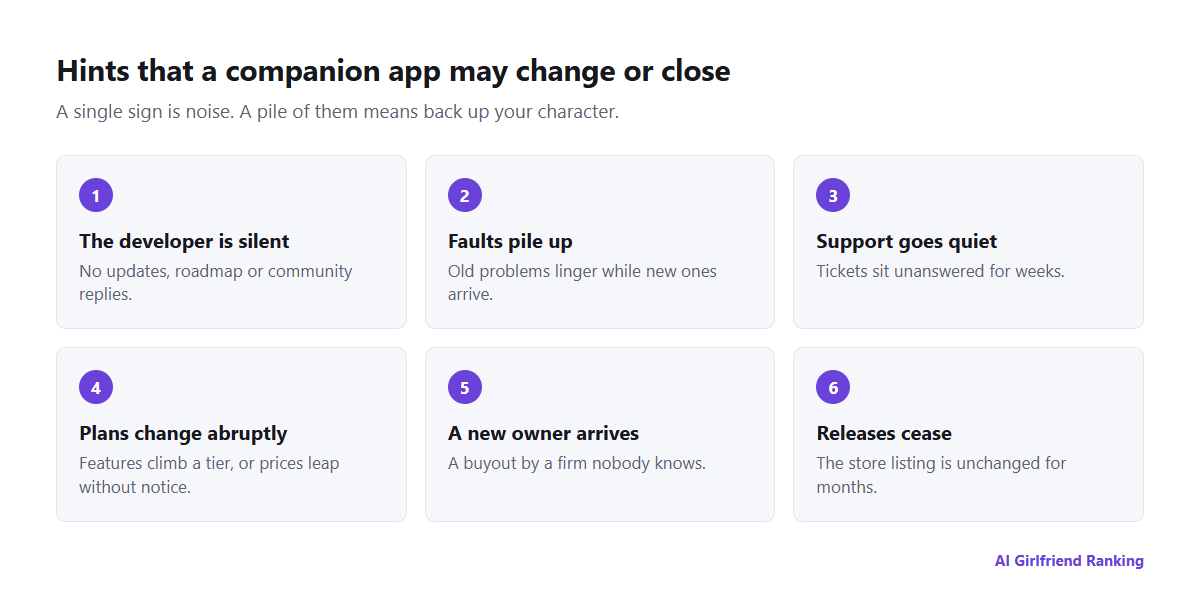
A cluster of these justifies action.
Much of what Soulmate's users noticed before the shutdown is typical of apps in difficulty: developers who go quiet, a growing pile of faults, unanswered help requests, an unfamiliar new owner. Any single one proves nothing. Taken together, they are a cue to update your character file now.
If it has already happened
- Wait a few days before starting over. Something rebuilt in the first hour usually disappoints, whereas a version made after a short pause tends to fit better.
- Start from the personality, not the logs. Give the new app the description plus some sample lines and let it settle into a voice. Insisting on a perfect replica leads to constant fixing.
- Accept that it will differ, at least partly. Many people find the new character has become its own within a fortnight or so.
- You may also simply stop. A closure can be a natural end point, and choosing it is a valid outcome and not a failure.
Anyone who wants this risk gone entirely has one full solution: a companion hosted on your own computer, where nobody can swap the model underneath you. It demands more effort, as running an AI companion locally describes, but it is the only arrangement in which the relationship is independent of a company's future choices.