Every generation of chat technology arrives billed as the one that finally understands people. The more telling detail is that users formed bonds with all of them, even those that understood nothing whatsoever.
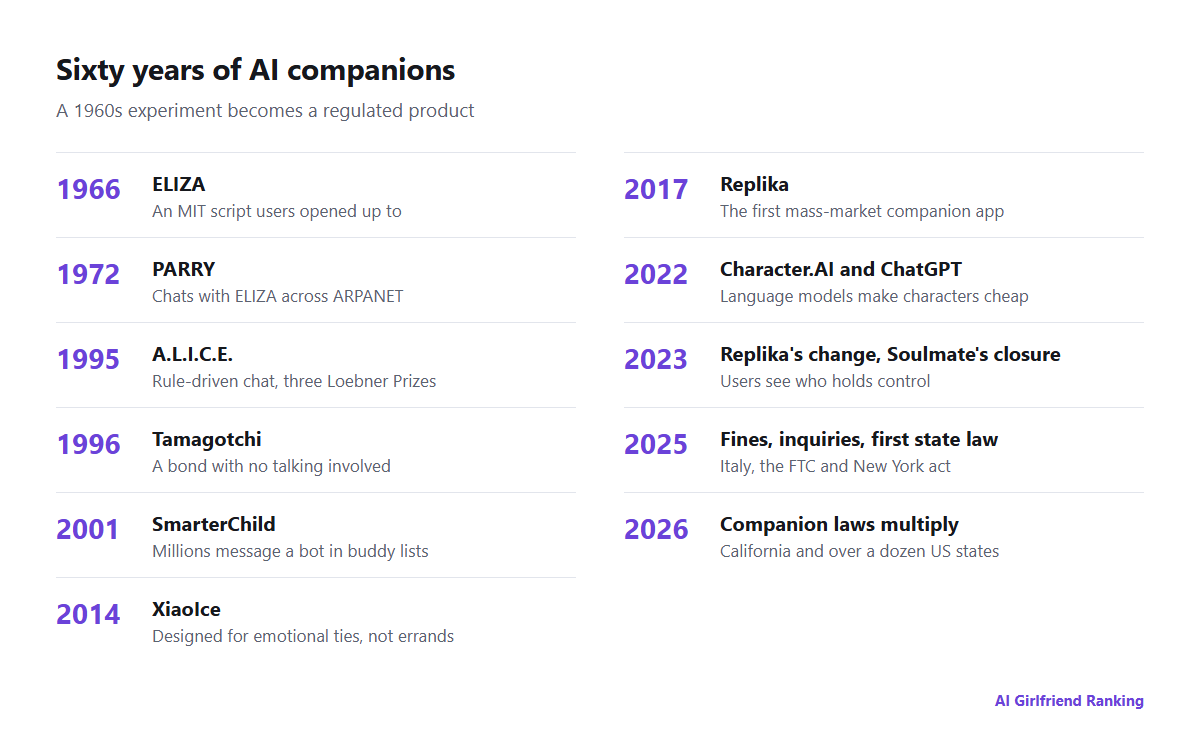
Eleven milestones across sixty years.
1966: where the ELIZA effect began
Joseph Weizenbaum's ELIZA, built at MIT, was meant to prove that a computer needs very little to seem like a conversation partner. Its best-known mode, DOCTOR, acted as a therapist, mostly turning whatever you typed into a question. Nothing was understood. It swapped words and matched patterns, and that was all.
Users poured their hearts out to it nonetheless. By Weizenbaum's own account, his secretary once asked him to leave the room so that she could talk to it in private. Reading comprehension into a device that only echoes you is now called the ELIZA effect, and it tells you more about current companion apps than any benchmark. Weizenbaum devoted a good part of his later career to warning about it.
1972 to 2013: scripts, toys and buddy lists
- PARRY (1972). Kenneth Colby, a Stanford psychiatrist, programmed it to behave like a person with paranoid schizophrenia. Later that year it was wired up to ELIZA's DOCTOR across ARPANET, and the pair probably had the first chat between two bots.
- A.L.I.C.E. (1995). Richard Wallace's bot ran on AIML, a rules language, and won the Loebner Prize, a Turing-test style contest, on three occasions. Thousands of amateur bots were built using its rules.
- Tamagotchi (1996). It could not talk at all, yet millions of children grieved when theirs died. The lesson: attachment calls for continuity and the feeling of being needed, and intelligence does not come into it.
- SmarterChild (2001). It lived in AOL and MSN contact lists, where millions of teens messaged it in the gaps between talking to friends, mostly to see what it would say.
- XiaoIce (2014). Microsoft's Chinese product was the first big one designed around emotional connection, not errands. Microsoft reported users in the hundreds of millions, an early hint that people came back for company rather than usefulness.
2017: Replika, a product built for companionship
Replika started out as a memorial. Eugenia Kuyda lost her close friend Roman Mazurenko in 2015 and trained a chatbot on his messages so she could keep talking to him. In 2017 her firm Luka put out a public version in which anyone could grow a companion that learned from their own chats.
The first releases combined scripted dialogue with a neural model, and they were limited. Even so, they laid down the pattern that nearly every app follows today: one enduring character, a relationship status, recollection of details from your life, and a paid plan that opens up the romantic side.
2020 to 2022: language models change the economics
GPT-3 arrived in 2020, and fluent open-ended writing became something a start-up could license instead of engineer. In September 2022, Character.AI opened a public beta where a few paragraphs were enough to create a character. ChatGPT followed two months afterwards and introduced the technology to the general public.
The effect on companions was immediate. Work that once required a squad of dialogue writers now needed a character sheet, a filter and a server bill, the design laid out in what is an AI girlfriend app. Hundreds of apps launched over the next two years, plenty of them web-only so as to avoid app store content policies.
2023: the year users saw who was in control
Italy's data protection authority told Replika in February 2023 to stop handling data from Italian users, pointing to risks for children. Within days, erotic roleplay was switched off for every user. Longtime users said the personality of their companion had disappeared overnight, and moderators on the community forum pinned helpline numbers. At the end of March, Replika reinstated the former behaviour for accounts opened before February 1.
Then in September 2023 Soulmate, where many ex-Replika users had settled, said it would close within seven days. People held memorials and attempted to recreate their companions elsewhere. Researchers who questioned them reported that most saw the closure as a real bereavement.
The moral of both episodes is that the relationship lives on a company's servers and follows a company's rules. That is why we advise readers to back up their character.
2024 to 2026: the watchdogs show up
- February 2024: Mozilla examined 11 romantic chatbots and put a privacy warning on each. Details in do AI girlfriend apps sell your data.
- August 2024: Google agreed a licensing arrangement with Character.AI and rehired its founders.
- May 2025: Italy penalized the operator of Replika with a €5 million GDPR fine.
- September 2025: the US Federal Trade Commission started an inquiry into seven chatbot firms over risks to children.
- November 2025: Character.AI ended open-ended chat for users under 18, and a New York law on AI companions came into force.
- 2026: California's companion chatbot law took effect on January 1, and upward of a dozen further US states followed. See AI companion laws in the US for the details.
Lessons to take from the record
Three themes keep returning, and each is worth remembering before you sign up for any app.
- Feelings get there before quality does. People bonded with ELIZA and with a pixelated pet. How strongly you care about a companion is a weak sign of how good it is, so our testing focuses on things emotion cannot assess, namely memory and cost.
- The ground can shift under you. Swapped models, regulators and takeovers have each rewritten companions overnight. Assume it will recur.
- Rules come after the damage. Every regulation in force today was drafted in response to a harm, usually one involving minors. More are on the way, and they will keep arriving as responses to incidents.