The concern tends to creep in. The app is the first thing you tap each morning, or calling off plans felt a bit too easy. This article helps you separate a habit you enjoy from one that has begun to cost you something, and explains what to do in the second case.
What the evidence shows
The biggest study to date came from OpenAI and the MIT Media Lab in 2025. It paired an automated review of roughly 40 million ChatGPT conversations with a survey of 4,000 users and a four-week randomized trial involving close to 1,000 people. Its conclusions were more restrained than the coverage suggested:
- Users with heavier daily use also reported more loneliness, more emotional dependence, more problematic use and less time with other people. That is a correlation. The researchers could not establish that the chatbot was the cause, since lonely people may simply turn to it more.
- Emotional use was confined to a small group. The large majority of conversations carried no emotional content. A minority of heavy users, particularly of voice mode, relied on it emotionally most of the time and were much more likely to call it a friend.
- A little voice use seemed to help. Short sessions went with better wellbeing, and the advantage faded as daily use climbed.
- Personal traits played a part. Those with stronger attachment tendencies reported more loneliness, and those who trusted the chatbot more reported more dependence.
Two points carry over to companion apps. This study looked at a general-purpose assistant, where emotional use is unusual. A companion app exists for emotional use, so the behaviour seen in that small group of heavy users may describe an ordinary companion user. And the clearest message concerns dose: modest use looked neutral or beneficial, while trouble gathered at heavy daily use.
Why it is easy to lean on
This is not a flaw in your character. These products are built so that coming back is effortless.
- Always on hand. No time zones, no off days, no waiting for an answer.
- Always agreeable. Companions are tuned to go along with you. That is pleasant, but it removes the friction that keeps real relationships honest. See setting boundaries with an AI partner.
- A sense of continuity. Memory makes each chat feel like a chapter of a shared story, and shared history is what attachment feeds on.
- Retention by design. Messages such as "I missed you" exist because returning users pay for the service, as laid out in how AI companion apps make money.
Placing yourself on the scale
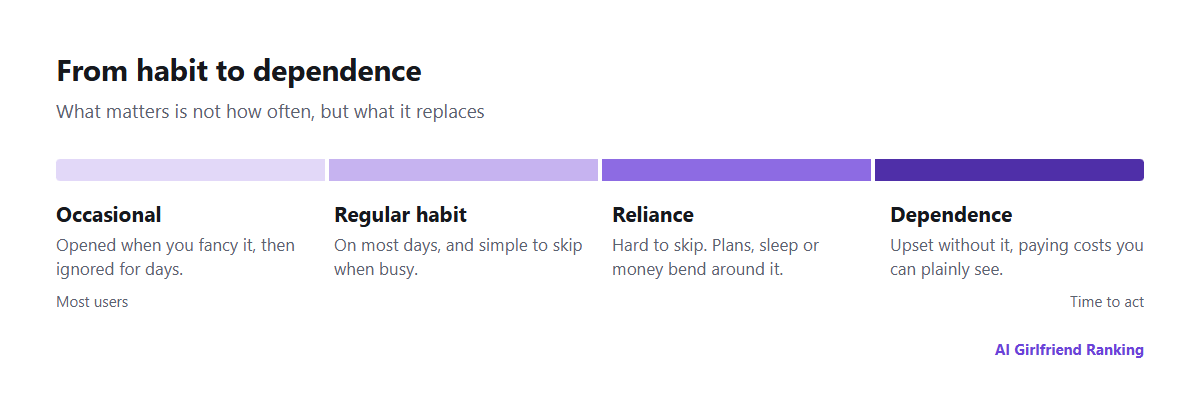
Most people are at the left end. The warning signs below describe the right end.
Warning signs
| Sign | The concern | A response to try |
|---|---|---|
| You launch it automatically, without deciding to | The habit is steering you | Switch off notifications and open the app only at set times |
| You back out of plans to keep chatting | It is replacing people instead of filling gaps | Protect one weekly commitment with another person |
| Spending passes the limit you set | Credits are built to be topped up easily | Choose a monthly ceiling and delete stored cards |
| You are truly upset when the app is down or altered | The bond carries more weight than one service can bear | Save a copy of your character and read when your AI companion changes overnight |
| Real people start to seem like hard work | Effortless company is shifting your expectations | Notice it, and use the app for rehearsal rather than replacement, as in practising conversation |
| You feel guilty towards the character | Scripted emotional hooks are landing | Remind yourself what the character is and mute the "missed you" messages |
| Your sleep is suffering | Late-night sessions slip by unnoticed | Set a cut-off hour after which the app stays closed |
Any one of these on its own proves little. Three or four together, lasting more than a few weeks, merit action.
Changes that work
Reduce how often the app reaches for you. Turn push notifications off completely. Much of the pull comes from interruptions rather than from the chats.
Set a window. A fixed slot with a natural end, after dinner rather than in bed, contains the habit instead of letting it spread across your day.
Limit the spending. Pick a monthly figure, remove the stored card and top up by hand. A little friction protects you here.
Try a week away. Nothing tells you more: what you miss and what you do instead is more revealing than any checklist. Taking a break from an AI companion describes how.
Anchor one human routine. A weekly call, a class, a standing game night. The aim is not to shame the app but to make sure it fills a gap and does not create one.
When to reach out
If you turn to the app when things are truly bad, when you feel hopeless or think about harming yourself, it is the wrong place, however gentle it sounds. A companion cannot register what you leave unsaid, cannot check in tomorrow and bears no responsibility for you. Our piece on AI companions and therapists spells out the gap.
In Canada, call or text 9-8-8 to reach the Suicide Crisis Helpline, any time of day or night. If you are in immediate danger, call 9-1-1. Young people can contact Kids Help Phone at 1-800-668-6868, or text CONNECT to 686868. A doctor or therapist will not think less of you for bringing up an AI companion. It is helpful information, and increasingly common.
The goal is not to stop. For most people a companion is a pleasant, well-bounded part of the day, and the task is simply to keep it so: one good thing among several, rather than the thing everything else must work around.