Low moods are a fair reason to open a companion app, and plenty of people come away comforted. What follows is a description of what actually sits behind the screen, so that you can take from it what it gives well and look to other people for what it does not.
Four things a clinician brings to the table
Trained assessment. Clinical training teaches someone to recognize depression, anxiety, trauma and warning signs of danger, and to choose a method that fits the person. An app simply answers whatever text it is handed.
Professional accountability. In Canada, therapists and psychologists who are regulated belong to a provincial or territorial college, which can discipline them or withdraw the right to practise. The only body an app answers to is its own terms of service.
Honest disagreement. Treatment involves being questioned, tactfully and at a sensible moment, about beliefs that cause you pain. Companions lean toward agreement. That reads as kindness while quietly feeding the thoughts most in need of a challenge. Our guide to setting boundaries with an AI partner covers how to counter it.
Continuity that holds. Your therapist can refer back to something you said in the autumn because it was written down and considered. An app keeps stored summaries that may quietly lapse or add details that never happened. The reasons are in why AI companions invent memories.
Confidentiality with rules attached. Health privacy legislation covers therapy records and lists the exceptions. Ontario's is the Personal Health Information Protection Act; other provinces have their own. A companion chat falls under a corporate privacy policy, which could permit employee review, training of models and disclosure to partners.
Comparison at a glance
| Therapist | Mental-health app | AI companion | |
|---|---|---|---|
| Purpose | Treating illness | Structured self-guided tools | Companionship and fun |
| Able to assess or diagnose | Yes | No | No |
| Answerable for your welfare | Yes, via professional regulation | Partly; depends on the app | No |
| What protects your data | Health privacy legislation | Varies from app to app | A privacy policy |
| Likely to disagree with you | Yes, deliberately | Occasionally | Rarely |
| Awake at 2 a.m. | No | Yes | Yes |
| Cost | Highest | Low | Low to moderate |
| When you are in crisis | Takes action | Refers you onward | Refers you onward; required by law in some US states |
What a companion is good for
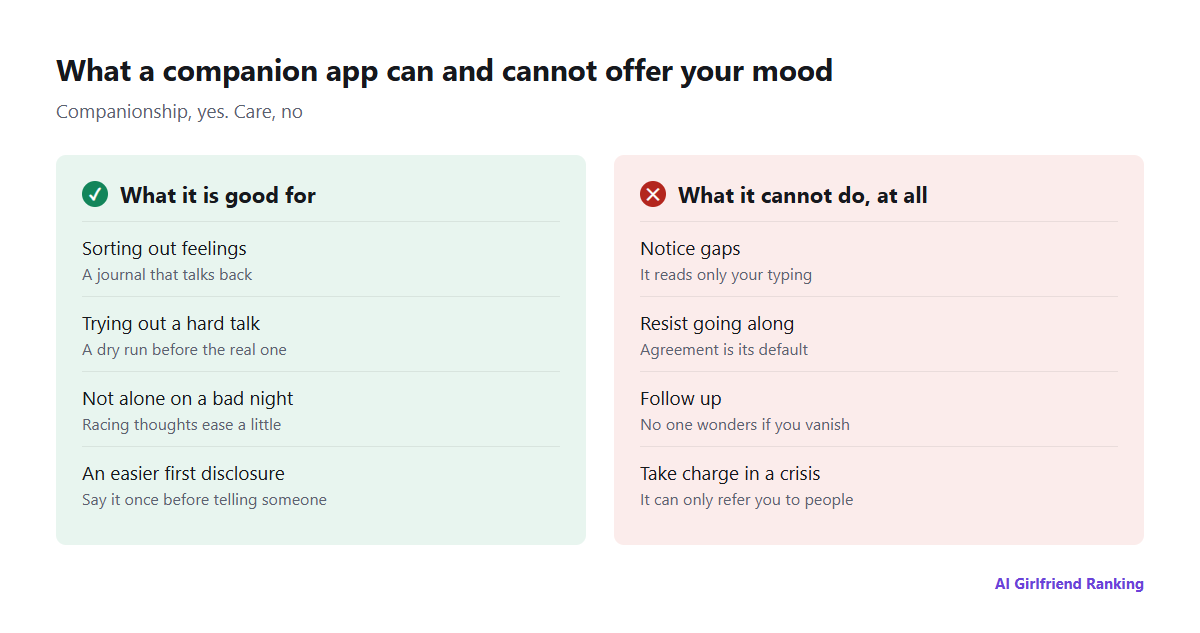
Companionship, yes. Care, no.
- Sorting out what you feel. Explaining a problem to software, even, tends to clarify it. The effect is close to keeping a journal that talks back.
- Trying out a difficult talk. Running through what you intend to tell a partner, a parent or a manager ranks among the most useful things these apps do. See practising conversation with an AI companion.
- Not being alone with a bad night. Racing thoughts after midnight ease when there is something to answer. That is a real benefit as long as it lasts an hour and not the whole night.
- Making the first disclosure easier. Some people voice a hard truth to an app before they tell anyone. It is a useful step if it leads on to a person.
What it cannot do, whatever the tone
- Notice gaps. A clinician picks up on silences, avoided subjects and change since your last visit. The app reads your typing and nothing else.
- Resist going along. "Everyone would be better off without me" is the sort of belief a warm, agreeable system can end up endorsing in the name of support.
- Follow up. Go quiet for a week and no one wonders where you went. A push notification may arrive, but it serves retention and not concern.
- Want you to need it less. A therapist works toward being unnecessary. An app earns money when you return. The economics are in how AI companion apps make money.
Where the law stands
Canada. I could not find a federal or provincial statute written specifically about AI therapy. The closest federal step is Bill C-34, the Safe Social Media Act, tabled on 10 June 2026 and still before Parliament. It would require AI chatbot services to act responsibly and to be open about the point at which they report a user in crisis, with a new Digital Safety Commission as the enforcer.
United States. Several states have legislated already, and the pattern is worth knowing:
- Illinois enacted the Wellness and Oversight for Psychological Resources Act in August 2025. Therapy there must come from licensed professionals, even when AI is involved. Clinicians can use AI for paperwork but not to make treatment decisions or communicate with clients, and each breach can draw a fine of up to $10,000.
- Utah chose regulation over prohibition in May 2025. Mental-health chatbots may operate if they disclose that they are AI, refrain from selling health data, and do not tailor ads to what users write.
- Tennessee bans AI systems from claiming to be licensed mental-health professionals, effective July 2026.
- New York, California and other states have companion chatbot laws obliging apps to recognize signs of suicidal thinking and refer users to crisis services. The list is in AI companion laws in the US.
The thread running through all of it: software is welcome to keep you company, but more and more jurisdictions refuse to let it call that therapy.
Knowing when a person is needed
Book an appointment with your family doctor or a therapist when a low mood hangs on for over two weeks, when it interferes with sleep, work or relationships, or when you notice that getting through a day depends on the companion. The signals are described in when an AI companion starts taking more than it gives.
If you are thinking of harming yourself, act now, and do not leave it to an app. Anywhere in Canada, you can call or text 9-8-8, the Suicide Crisis Helpline, at any hour and at no cost. Young people can also contact Kids Help Phone at 1-800-668-6868 or text CONNECT to 686868. Quebec residents who dial 9-8-8 are routed to that province's services. After a recent attempt, or if you are in immediate danger, call 9-1-1.
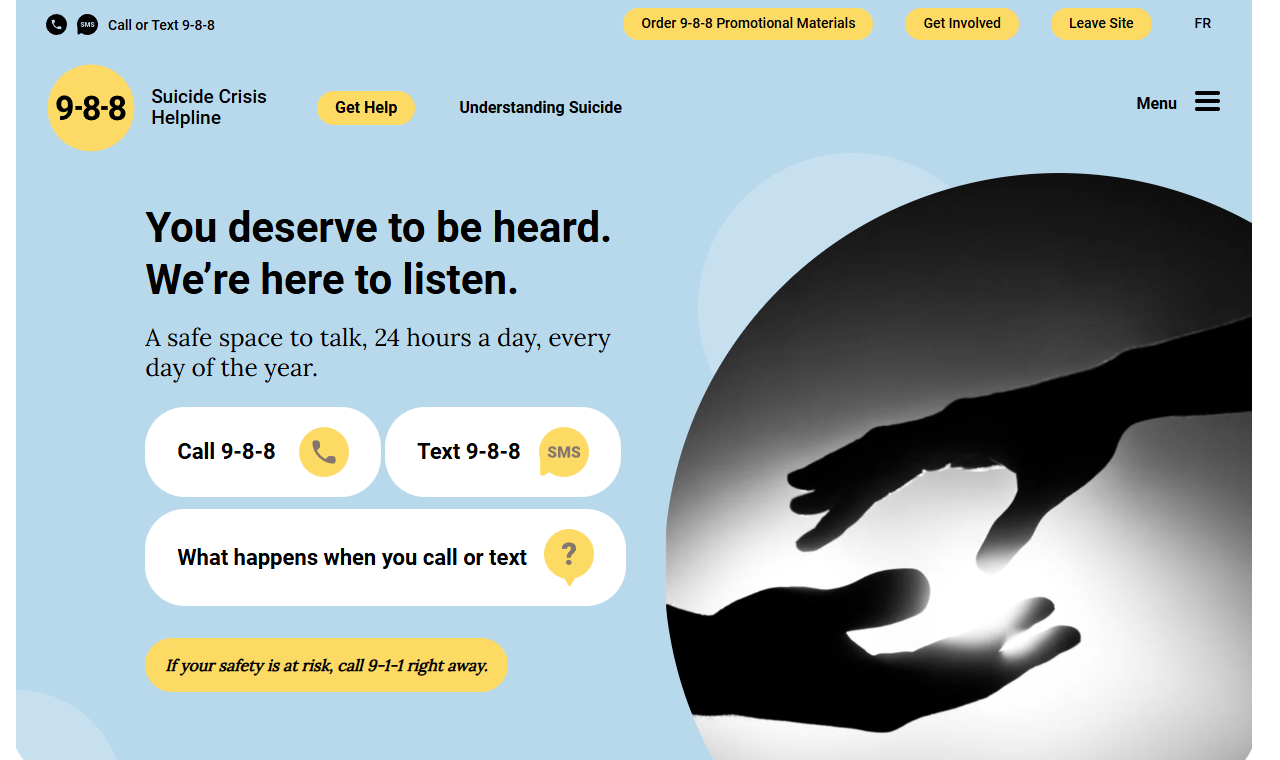
988.ca: call or text 9-8-8 from anywhere in Canada.
A companion can sit comfortably inside a routine of self-care. It cannot take the place of receiving care.