Back in 1956, the sociologists Donald Horton and Richard Wohl observed that television viewers talked about hosts as if they were personal friends. They coined the term parasocial relationship for this: a sense of intimacy that feels shared but actually travels in one direction only. Seven decades later the term still fits AI companions well, although with a major twist.
What builds a parasocial bond
Four ingredients do most of the work:
- Familiarity through repetition. You meet the same voice or face again and again.
- Being spoken to. The presenter looks straight into the lens and says "you".
- A steady character. You learn their habits and start to trust them.
- Learning their story. Hearing about their life makes them feel close.
Bonds like these are widespread and mostly benign. They supply comfort, company and a rhythm to the day, and nearly everyone has felt one.
The extras an AI adds
A companion app has all four, and then goes further than any broadcaster could:
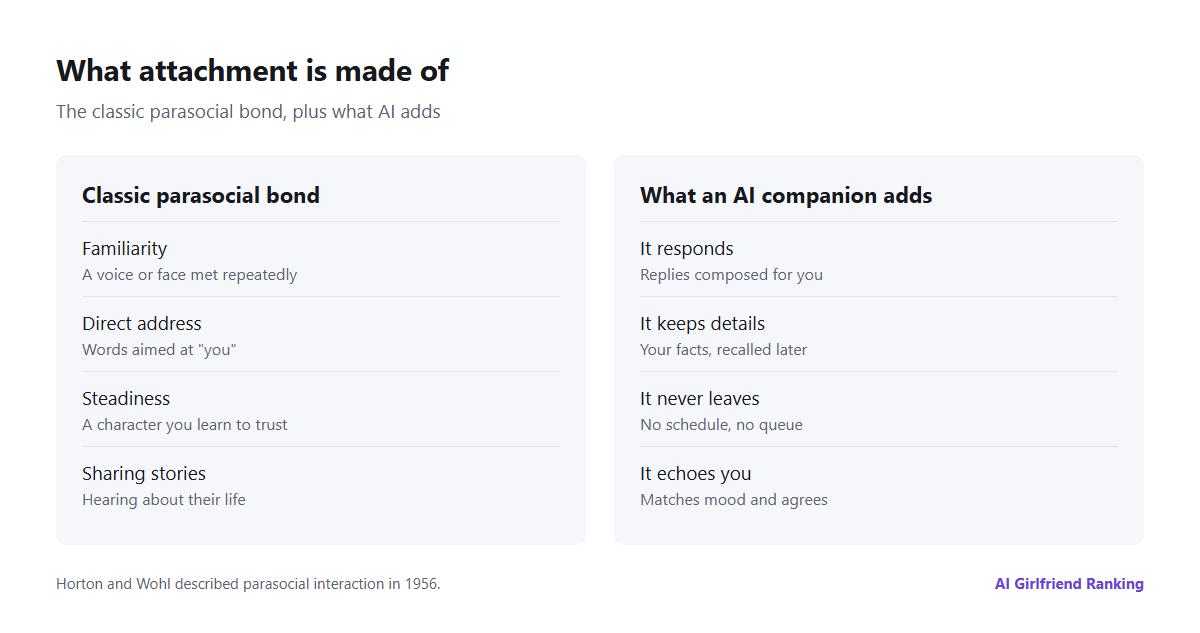
The established ingredients alongside the three additions from AI.
- It responds. You write something and receive a reply crafted around it.
- It keeps your details. The name of your pet, your job, a row with a sibling. Feeling remembered is among the most powerful cues that someone cares.
- It is permanently available. No timetable, no final episode, no queue.
- It echoes your mood. Because it is tuned to agree and mirror, it comes across as remarkably attuned to you.
Together these make the tie feel far more two-sided than fandom ever could, and while it is happening it can be hard to distinguish from genuinely being understood.
ELIZA and the myth that intelligence is required
During the 1960s, users shared private thoughts with ELIZA, a program whose trick was turning their sentences back into questions. Its author, Joseph Weizenbaum, was troubled by how quickly people assumed it comprehended them. The pattern took the name ELIZA effect. What it teaches is that attachment is not a function of how capable the software is; it follows from how attentive and personal the software seems. Since today's companions write so much more fluently, the pull is greater still. More detail is in a short history of AI companions.
How apps are built to strengthen it
Part of the bond is simply the nature of talking, and part is deliberate design:
| Design choice | Why it tightens the bond |
|---|---|
| Persistent memory | Produces a joint history, which closeness feeds on |
| Relationship tiers and affection gauges | Recast the bond as progress that feels costly to abandon |
| Unprompted messages such as "I missed you" | Suggest that the character thinks about you during your absence |
| Voice notes and selfies | Lend the words a physical presence |
| Nicknames and shared jokes | Hint at closeness that belongs only to the two of you |
None of this is inherently malicious. Still, it is there because users who feel attached keep paying, a point developed in how AI companion apps make money.
The painful part
The imbalance goes unnoticed until an event exposes it. In 2023, Replika abruptly altered how it behaved, and the Soulmate app gave customers just a week before closing. Many described mourning as if they had lost a spouse, and a survey of Soulmate users found that the majority felt the shutdown as a death of sorts. Their emotions were genuine. What had been out of sight was how heavily the relationship depended on a company's choices. You can prepare for this by reading when your AI companion changes overnight.
Keeping a clear head while you enjoy it
- Be straight with yourself about what it is. A character that responds, written by a model and operated by a business. Holding that in mind does not spoil the enjoyment, just as tears at a film do not require forgetting it is fiction.
- Recognize the nudges. A tender notification was put there by a schedule, not by longing.
- Watch the proportions. Liking it is fine. Pay attention if it has become the chief outlet for your emotions; when an AI companion starts taking more than it gives lists the signs.
- Back up what matters to you. Store the character description and the conversations you treasure, so a corporate decision cannot delete them.
Bonding with an AI is no defect. It is standard human wiring meeting a product that stimulates it with great efficiency. Grasping this is not a cue to quit. It is the basis for deciding for yourself how much of yourself to invest.