Before trusting any number about AI companions, ask three things: who counted, what was counted, and where. A count taken from app stores misses services sold only on the web, and a survey answer depends on how the question was phrased. Market "forecasts" are frequently advertising in disguise.
Note that most of the usage surveys below were run in the United States. They are labelled as such, and I have not found a comparable Canadian survey that meets the same standard, so I have not substituted one.
The main numbers
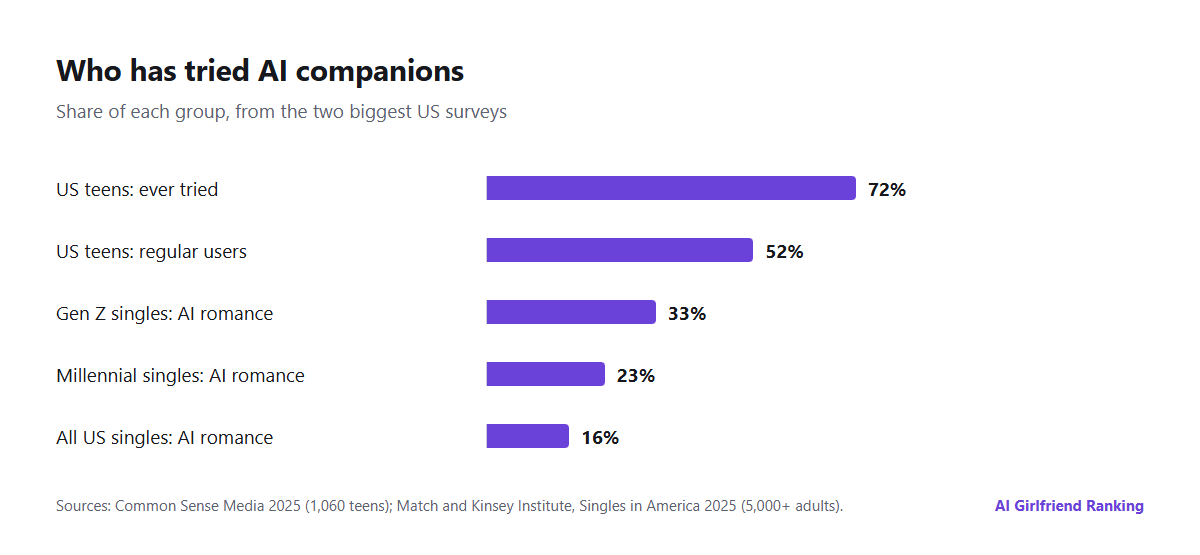
The proportion of each group that has used AI companions, from the two largest US surveys.
| Measure | Result | Published by | What is counted |
|---|---|---|---|
| Total companion app installs to date | 220 million | Appfigures (July 2025) | Apple and Google stores only |
| In-app revenue, January to June 2025 | $82 million | Appfigures | Phone stores; no web sales |
| Expected in-app revenue, full-year 2025 | Above $120 million | Appfigures | An estimate for phones only |
| Companion apps with revenue | 337 | Appfigures (mid-2025) | Of these, 128 began in 2025 |
| Share of income going to the top tenth of apps | 89% | Appfigures | Very few apps dominate |
| American teens who have ever tried one | 72% | Common Sense Media (2025) | A sample of 1,060 teens, ages 13 to 17 |
| American teens using one regularly | 52% | Common Sense Media (2025) | Monthly or more often |
| American singles who have had a romantic exchange with AI | 16% | Match and the Kinsey Institute (2025) | More than 5,000 adults; caveat below |
| Same question, Gen Z singles only | 33% | Match and the Kinsey Institute (2025) | |
| Singles who call an AI partner a form of cheating | 40% | Match and the Kinsey Institute (2025) |
About the Match number: press coverage of the survey indicates that the romantic-companion category may also sweep in people who merely used AI to help write dating profiles or messages. Treat 16% as the upper limit.
What they are used for
From the Common Sense Media survey of teens:
- A third of teens turned to AI companions for social or relationship purposes: conversation practice, emotional support, roleplay and romance.
- Among teen users, 39% reported using a social skill they had rehearsed with AI in real life.
- Another 31% rated AI chats as at least as satisfying as talking to friends, although 80% still gave more of their time to real friends.
In the Match survey of adults, singles with an AI partner gave two headline answers: 45% said it left them feeling better understood, and 44% said the emotional support was stronger than what they got from people.
A modest market, led by a few
Consumer AI apps as a whole took in over $1.4 billion in 2024 by Appfigures' count, and companions are only a slice of that. The slice is expanding fast, though. Downloads for January to June 2025 were up 88% from a year earlier and revenue per download more than doubled. Income is concentrated in a handful of apps; the rest of the category's hundreds make very little.
Phone-store data leaves two things out:
- Web subscriptions. A lot of adult-focused apps sell chiefly or only through their websites, in part to sidestep store content policies. None of it appears in store statistics; compare buying in a browser versus an app store.
- General-purpose chatbots used as companions. Plenty of people chat with ChatGPT, Claude or Grok in a companion-like way. A joint OpenAI and MIT study found emotional use of ChatGPT to be rare overall yet concentrated among a few heavy users.
Claims that deserve scepticism
- Projections of a market worth $X billion by 2030. These range wildly, and the firms publishing them usually sell the reports.
- User totals announced by the apps. Registrations do not equal active users.
- Engagement claims about one character, such as daily minutes, which usually trace back to unsourced blog posts.
- Percentages without a base. Forty per cent of which group, and asked in what way?
Following the data
New category reports come from Appfigures and comparable analytics firms. Common Sense Media and the Singles in America study (Match with the Kinsey Institute) run their surveys again periodically. Scholarly research on wellbeing is covered in what the research says about mental health, and the economics of the category are laid out in how these apps earn their money.