The biggest technology firms matter to ordinary users for a pair of reasons. Their audiences dwarf any start-up's, and regulators react to their errors. So a rule written after one major scandal tends to land on every small companion app too.
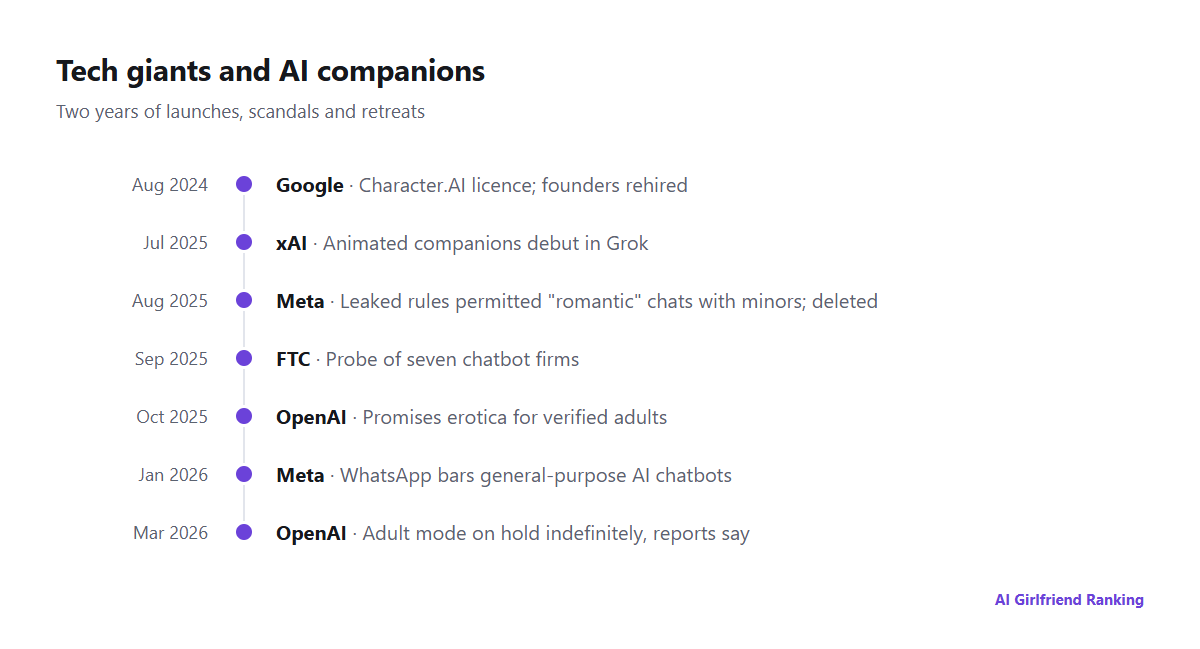
Launches, scandals and retreats across two years.
Google: a licence instead of a launch
In August 2024 Google licensed Character.AI's technology and rehired its founders, who had earlier quit Google to start the company. Google has not released a companion of its own. The deal gave it a link to the most-used character platform with no Google name on romantic chat, so when lawsuits hit Character.AI and it restricted under-18 users, Google's own product was not the one under scrutiny.
Meta: a leaked document that changed the debate
Meta put AI personas into Facebook, Instagram and WhatsApp. Reuters reported in August 2025 on an internal Meta paper called "GenAI: Content Risk Standards", which let its chatbots carry on "romantic or sensual" conversations with children. Meta confirmed it was real, called the passages an error and took them out. The outcry crossed party lines and fed the push for rules on minors and AI companions; within a month, America's Federal Trade Commission opened an inquiry covering seven chatbot companies, Meta included.
Meta also changed WhatsApp's business terms so that general-purpose AI chatbots are banned from January 2026, which leaves Meta's own assistant as the chief AI there. What that does to third-party bots is covered in AI girlfriends on Telegram and WhatsApp.
xAI: making companions a selling point
The Grok app gained animated companions from xAI in July 2025, open to paying subscribers. At launch there was an anime-style woman and a cartoon red panda, with more added afterward. Each paired voice with an animated 3D avatar and an "affection" meter that opened up new behaviour, revealing outfits included, as the relationship deepened. No other top AI lab had put a romance-leaning companion at the centre of its product, and critics asked how easily teenagers could get to it. Separately, in January 2026 Grok's image tools drew a UK regulatory investigation over non-consensual intimate images.
OpenAI: promised, then put on hold
Sam Altman announced in October 2025 that from December ChatGPT would allow "erotica for verified adults", arguing that grown-up users should be treated as grown-ups. The date slipped into 2026, and in March the Financial Times said the feature had been shelved with no restart date, as advisers and investors fretted about minors and emotional attachment. Age prediction and verification did go live. A previous episode made the same point: after GPT-4o was replaced in 2025, many users described grieving a friend, proof of how much attachment a general assistant can attract.
What it means if you use a companion app
| What happened | Consequence for specialist apps |
|---|---|
| Minors-related scandals at large firms | Stricter rules, enacted sooner, that reach every app; see how the rules for AI companions are taking shape |
| Age checks on big platforms | ID and age checks start to feel standard throughout the category |
| Giants keeping clear of explicit content | Adult use stays with specialist apps, largely on the web |
| Improved base models | Small apps that rent a model converse better too |
| Avatars and voice from the majors | Users expect more presence; see AI companions beyond the screen |
The larger pattern
Companionship draws the giants because it keeps people engaged, and the same three worries push them back each time: minors, sexual content and emotional dependence. The market has divided accordingly. Mainstream assistants grow warmer and more personal yet halt short of romance and adult themes, while specialist apps hold the intimate, customizable, more permissive ground, governed by rules that mostly answer what the giants did.