Messenger bots do have a pull. The character turns up beside your friends, alerts work without any setup, and voice notes feel natural. What you give up is oversight, since nothing here is checked the way an app-store listing or a well-run website would be.
Why the bots end up in messengers
- Nobody vets them. Apple and Google limit sexual content and review each app before it is listed. A bot skips that gate entirely; the rules are covered in browser or app store.
- Launching is nearly free. The operator needs a server and a language model, and no finished app.
- Spreading is easy. Channels, groups and forwarded links carry a bot far on their own.
CarynAI, the first influencer clone, lived on Telegram in 2023 and charged per minute. When its operator's company collapsed, subscribers were locked out overnight.
The WhatsApp change
In October 2025 Meta rewrote the WhatsApp business platform terms so that general-purpose AI chatbots, meaning bots whose main offering is open-ended conversation with an AI, were no longer allowed. The rule applied from 15 January 2026, and large assistants such as ChatGPT and Perplexity pulled out. Bots for customer service, bookings and orders can stay, and so can Meta's own assistant.
For companion users the upshot is simple. A WhatsApp number selling an "AI girlfriend" is either breaking platform rules, and probably heading for a shutdown, or is not really an AI service at all.
Where Telegram goes wrong
Anyone can run a bot on Telegram, and the category includes some of the most damaging services online. In 2024, Wired found at least 50 "nudify" bots that claimed to turn ordinary photos of real people into explicit images, with over 4 million monthly users between them. Telegram removed them after being contacted, and replacements soon appeared.
Plenty of companion bots are not like that, but they share the same structural weaknesses:
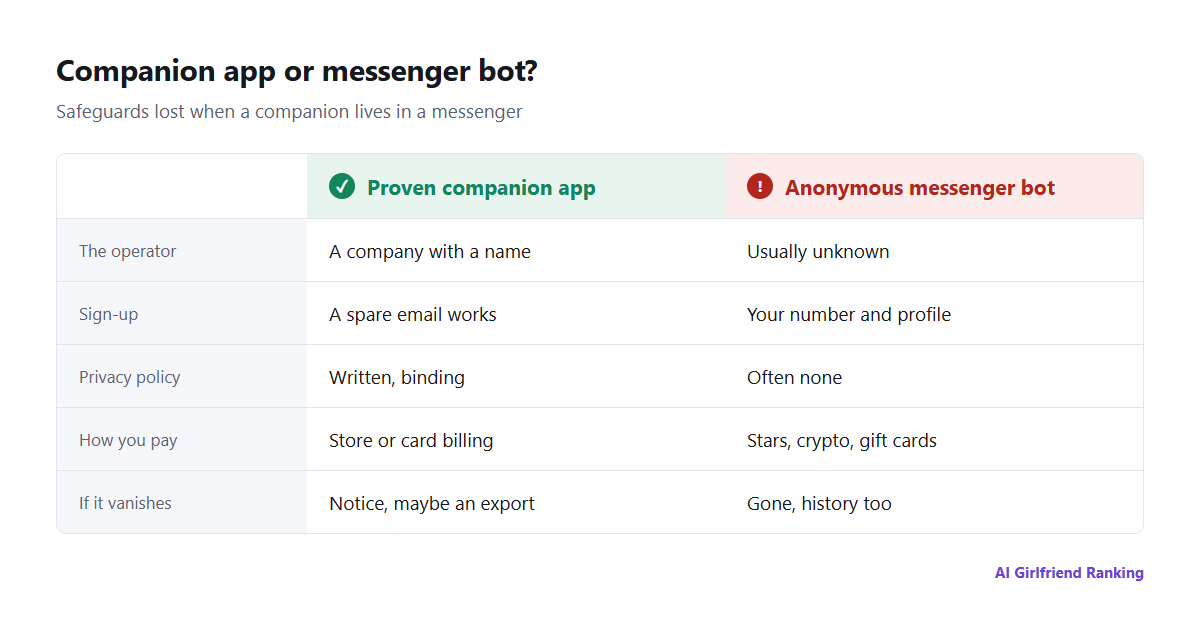
The safeguards that disappear when the companion lives inside a messenger.
| Factor | Established app | Anonymous messenger bot |
|---|---|---|
| Who is behind it | A named company | Often no one you can identify |
| Privacy policy | In writing, and binding on the company | Often missing altogether |
| Removing your data | A set procedure, backed by privacy law | Typically no way to ask |
| How you pay | Store billing or a card checkout, with refund options | Stars, crypto, payment links, gift cards |
| Content rules | Filters, age checks and legal duties | Whatever the owner feels like |
| If the service vanishes | A notice, sometimes an export | Gone, chat history included |
The particular dangers
- Your phone number becomes your login. An app lets you register with a throwaway email, whereas a messenger bot sees your real number and profile.
- The operator can read everything. Any AI service must see your messages in plain text, and ordinary Telegram chats lack end-to-end encryption to begin with.
- Money moves outside a checkout. Many bots sell credits by link or crypto, which is also how scammers collect. See romance scams in the age of AI companions.
- Pictures of real people. A bot asking for a photo so it can "make her look like someone" is offering deepfakes. In Canada, sharing sexual deepfakes of a real person without consent is now a Criminal Code matter under Bill C-16, which received royal assent in June 2026.
- Sudden disappearance. Bots get banned, abandoned or renamed constantly, and your history disappears with them.
If you still want to try one
- Start from the company's own website. Never follow a link posted in a channel or group. A genuine app that runs a Telegram bot lists it on its own pages.
- Find the privacy policy and the company name before sharing anything personal.
- Use only official platform payments or a standard checkout. Crypto and gift cards are out.
- Upload no photos of real people, yourself included.
- Stay where you started. A bot urging you to switch to a different messenger or follow a private link is waving a red flag.
If you have already been scammed
Contact your local police first, then report it to the Canadian Anti-Fraud Centre at reportcyberandfraud.canada.ca or by phone at 1-888-495-8501 (toll-free, weekdays, Eastern time). Hold on to screenshots, payment receipts and the bot's username. If you paid by card, tell your card issuer too.
The ease of a messenger bot is real. For most people, though, a companion app or its web version gives the same conversation with a company accountable for it, a policy you can point to, and a way out when you want one.