The two are not hard to tell apart, and most people manage it. They do overlap on the surface, though: warm messages, attention on demand and a request for payment. Scammers know that people who already chat with AI are at ease with all three.
How big the problem is
The Canadian Anti-Fraud Centre (CAFC) counted 1,172 romance scam reports from 1,030 victims in 2024, with reported losses of $58.4 million. That put romance scams third among all fraud types by dollars lost that year.
Those totals include only people who came forward. Police and consumer agencies regularly note that many victims say nothing, often out of shame.
Across the border, for comparison only: American victims told the Federal Trade Commission they lost US$1.14 billion to romance scams in 2023, and the median loss of US$2,000 was the highest of any impersonation scam. In 2025 the FTC also heard from US victims that close to 60% of the losses began on social media, where the pitch was tailored to a profile and the ask arrived as a sudden emergency or a friendly investment tip.
What AI has taken away from the usual warning signs
Not long ago a romance scam was easy to catch: broken grammar, stock photos that showed up in a reverse image search, a new excuse every time a camera was mentioned. AI has wiped out most of those giveaways.
- Polished text in any language. A scammer no longer needs to write well or speak yours.
- Faces that exist nowhere else. Generated portraits slip past reverse image search.
- Live fakes. Face swapping and voice cloning now run in real time on ordinary computers.
- Volume. One person, with a chatbot typing, can sustain dozens of convincing chats at once.
So the old advice to ask for a video call no longer settles anything.
Four checks that separate an app from a con
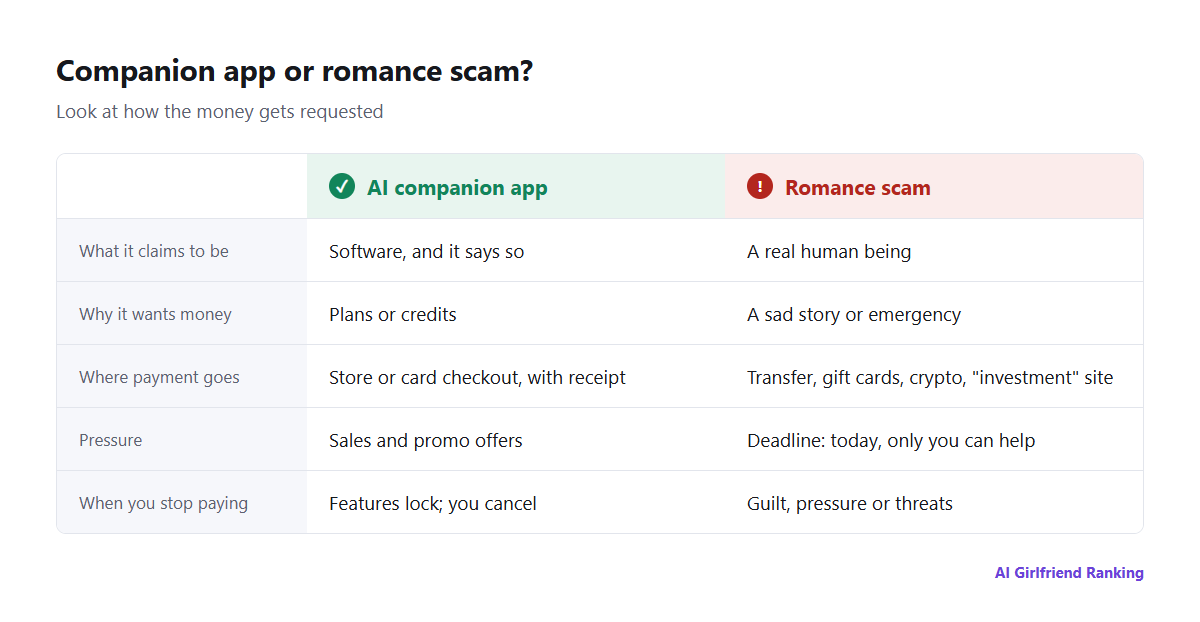
Where a companion product ends and a con begins.
1. It says it is a human. A companion app tells you it is an AI. A "person" you met online who is oddly available, endlessly agreeable and never able to meet in person is the opposite. For the legal picture, see how the rules for AI companions are taking shape.
2. Payment happens away from a checkout. Companion apps bill through an app store or a card payment page, with a receipt and a way to cancel. Scams ask for bank transfers, gift cards, cryptocurrency, or a deposit on an "investment platform" you have never heard of.
3. A crisis arrives with a deadline. A hospital bill, a customs fee, a frozen account, a flight home: always urgent, always fixable only by you, always today. Products do not behave this way. People running a con do.
4. It wants to move the chat. The conversation is steered to WhatsApp, Telegram or another private messenger, out of reach of the platform's moderation and your chat history.
A single one is reason to pause. Two at once leave very little doubt.
Scams that target companion-app users
Some fraud is aimed at people who already use AI companions, since they are known to spend money on digital intimacy.
- Imitation apps. Clones of well-known apps with slightly altered names, found in app stores or in ads. Install only from the official store listing or the company's own website.
- "Premium unlock" deals. Bargain lifetime access, cracked versions or credit bundles sold on Telegram channels or social media. At best the money is gone; at worst you have handed over your login.
- Account takeover. Phishing emails dressed up as billing problems. A hijacked account opens your whole chat history, and the defences are covered in securing your companion account.
- Sextortion. Intimate images, real or generated, used to demand payment. Anything shared in an app or chat can leak, as described in where your generated pictures end up.
- "AI girlfriend" social media profiles. Accounts that pose as an AI or a model and steer you to a payment link in a private message. A real product has a website and a checkout, not a DM.
If money has already gone
- Stop paying. This covers the "last fee to release everything," which is always in the script.
- Call your bank or card issuer at once. A transfer or card payment can sometimes be stopped or disputed if you move fast.
- Keep all of it: messages, usernames, wallet addresses, receipts. Do not delete the conversation, however much you want to.
- Report it to the Canadian Anti-Fraud Centre at reportcyberandfraud.canada.ca (or 1-888-495-8501, weekdays), and to your local police, who the CAFC asks victims to contact as soon as possible.
- Turn down recovery services. Anyone who offers to retrieve your money for a fee belongs to the same scam and targets people who have just reported a loss.
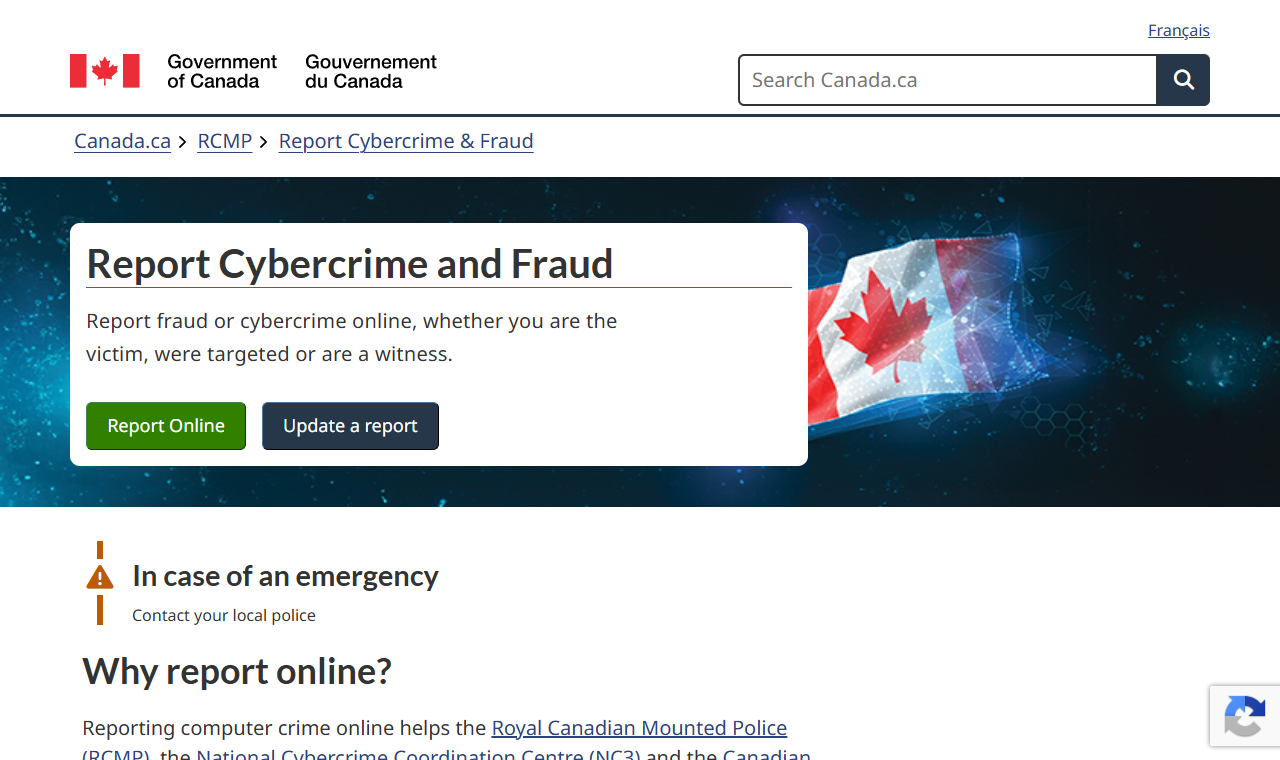
reportcyberandfraud.canada.ca, the national online reporting system.
A rule of thumb
An app may be expensive, keep nagging you to upgrade, or just disappoint, and still be what it says it is. A romance scam is false from its first message. Follow the money: a companion collects it only at its own checkout, and anything asking in some other way is not a companion, whatever it calls itself.