In brief: AI companions dependably ease loneliness in the moment, a small share of heavy users appear to fare worse, and the long-term picture is almost blank. The detail is more useful than either headline.
The main studies side by side
| Study | Design | Main result | Weakness |
|---|---|---|---|
| Maples et al., Stanford (2024) | Questionnaire given to 1,006 students using Replika | They scored lonelier than students in general, and many found the app useful. 3% said unprompted that it had ended suicidal thoughts | Based on self-reporting, with nobody to compare against |
| De Freitas et al. (2024, published 2026) | Several experiments, including one over a week | A single session cut loneliness by about the amount a chat with a person does, mostly because users felt heard | Covers short-term effects only |
| OpenAI and MIT Media Lab (2025) | Around 40 million conversations examined, 4,000 people surveyed, about 1,000 followed for four weeks | Users with heavier daily use tended to be lonelier, more dependent and less social | Correlation, and the tool was a general chatbot, not a companion app |
| Common Sense Media (2025) | Poll of 1,060 US teens | 72% had tried AI companions, and 39% of the users said skills had crossed over to real life | Self-reported; teens only |
What the studies support
Short-lived relief holds up. The most solid experimental finding is from Julian De Freitas and colleagues. Participants felt less lonely after using an AI companion, about as much as after chatting with another person and more than after watching videos. They also underestimated the benefit beforehand. The active ingredient was the feeling of being heard.
A few users describe a turning point. Among Replika users in the Stanford survey, 30 of 1,006 students (3%) wrote, unasked, that the app had put an end to suicidal thoughts. That is a striking number, but it was taken from free-text comments and is not a measured result. It shows that some people credit the app, and does not show that the app caused the change.
Skills may carry over. Of the teens who used AI companions, 39% said they had applied in real situations something they had practised with the AI.
What the studies warn about
Amount of use appears to matter. In the OpenAI and MIT research, more time each day, in any form, accompanied greater loneliness, deeper emotional dependence and less time with people. Brief voice sessions matched better wellbeing; heavy use did not.
Most of the risk sits with a few people. Emotional use was concentrated among a minority of heavy users, far likelier to call the chatbot a friend. Emotional use is the norm on companion apps, so that group is probably bigger there.
Personality plays a part. People with stronger attachment tendencies reported more loneliness, and those who trusted the chatbot more reported more dependence.
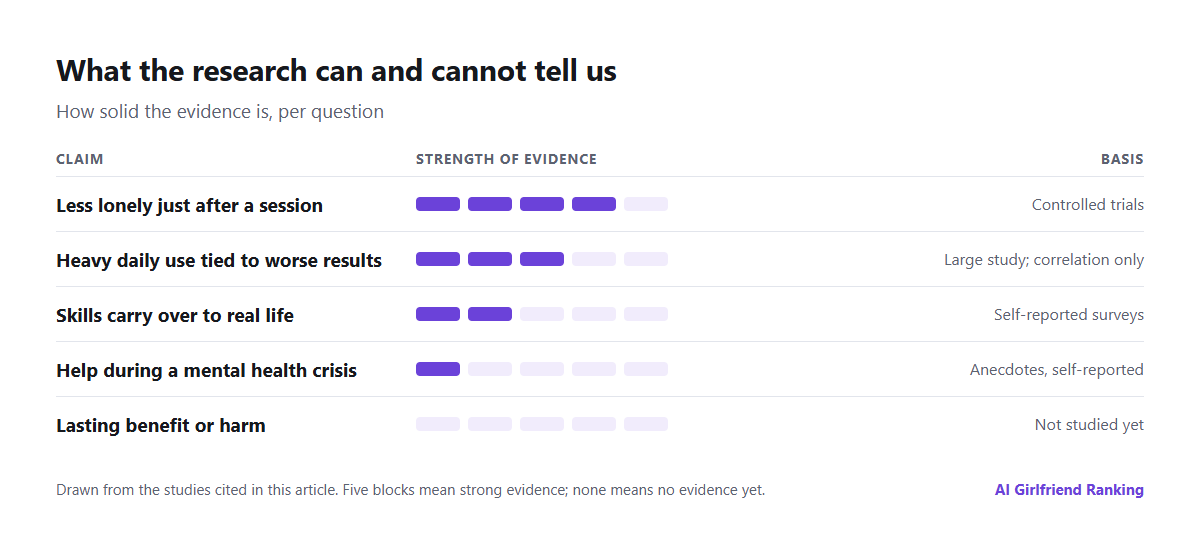
The state of knowledge, question by question.
What is still unknown
- Years of use. Nobody has followed companion users for several years. It is unknown whether short-term relief accumulates into lasting wellbeing or whether dependence wears it away.
- Which comes first. Lonely people may simply spend more time with companions, and current data cannot separate that from the companion causing the loneliness.
- People at higher risk. Controlled research on people with serious mental illness, or on minors, barely exists. That gap partly explains why several US states now regulate companion apps for young users; see AI companion laws in the US. In Canada, a federal bill tabled on 10 June 2026 (Bill C-34, the Safe Social Media Act) would put a duty on AI chatbot services to protect children, but it has not passed.
Judging the research yourself
- Find out who ran it. The biggest chatbot study was co-run by OpenAI. That does not make it wrong, and its results were not flattering, but it is worth knowing.
- Check the product studied. Findings on ChatGPT, a general assistant, cannot simply be applied to apps designed for intimacy, nor can findings on companions be applied to ChatGPT.
- Match the time frame. "Right after a session" and "a year later" are not the same claim.
- Look at the measurement. "Users said it helped" is a weaker finding than "a measured outcome improved against a control group."
What it means for you
A moderate view fits the evidence best. A companion can give real comfort, particularly in a lonely patch, and short regular sessions look harmless for most people. The concern is heavy daily use, most of all when it begins pushing out time with other people. The signs are listed in when an AI companion starts taking more than it gives.
When the problem is more than ordinary loneliness, for instance a low mood that will not lift, anxiety that shrinks your life or thoughts of self-harm, nothing in the research backs using a companion instead of care. An AI companion is not a therapist sets out the difference. In Canada, you can call or text 9-8-8 at any hour to reach the Suicide Crisis Helpline, and in an emergency, call 9-1-1.