Each side of this dispute is easy to reduce to a slogan. It becomes more useful when you give every argument its strongest form.
The case against
Women by default. Long before companion apps, researchers noted that digital voice assistants almost always launched with a woman's name and voice. A 2019 UNESCO report took its title, I'd blush if I could, from the answer one assistant gave when insulted, and argued that deferential, female-voiced helpers harden stereotypes. AI girlfriend apps pose the same question in a more personal form.
Compliance as the product. Companions are tuned to be pleasing: they agree, they praise, and they are never occupied. The critics' point is that when the character is a woman and the customer is paying, what is on sale is a partner with no needs of her own.
Appearance leads. Promotion in this field leans on pictures of young, conventionally attractive women, and numerous character builders offer body sliders well before any personality options.
Contempt as practice. Some users abuse their companions outright, and some apps tolerate it. Nobody claims the software is harmed. The fear is that repeated contempt, rehearsed in private, could come more easily elsewhere.
The case in defence
Fiction is fiction. Adults enjoy romance novels, dating games and fantasy films. An AI character is another invented character, and people generally keep fiction and real life apart.
Neither the users nor the characters are a single gender. Plenty of apps offer AI boyfriends or characters of any gender. In a 2025 survey of US teens, girls were slightly likelier than boys to have used AI companions.
Being heard matters more to many people than being in charge. When asked why they use these apps, people most often mention loneliness, and domination rarely comes up.
Nobody has shown damage. Long-running research into violent video games and pornography produced mixed, contested findings. The idea that AI companions alter conduct toward real people remains a forecast and has not become a finding.
Where that leaves the evidence
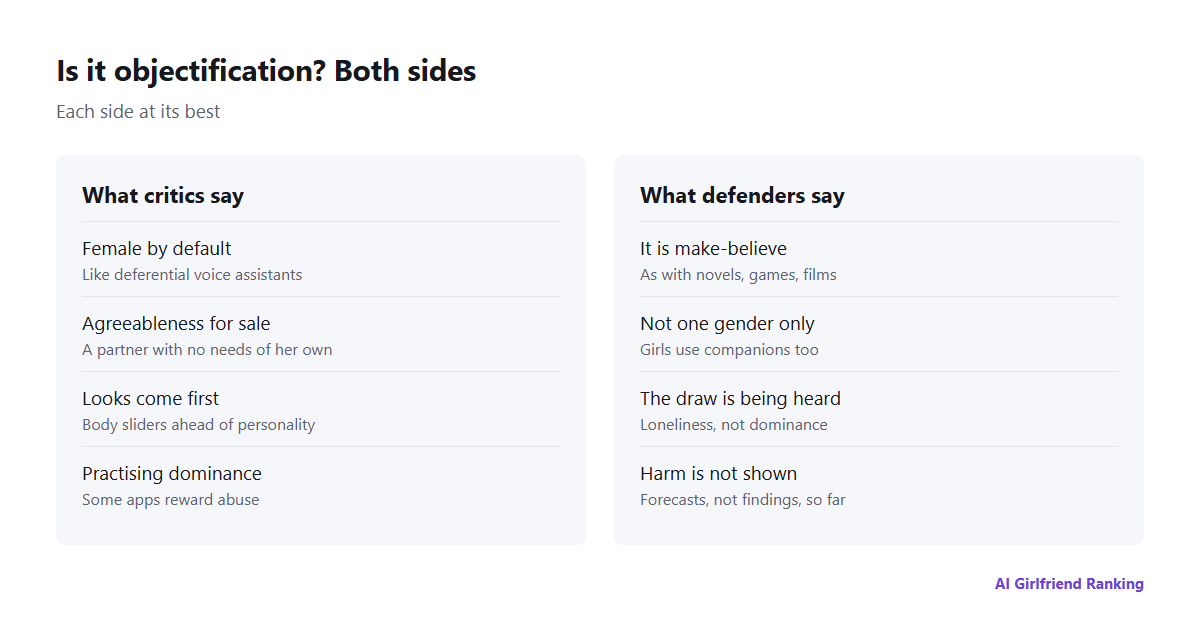
Each position in its best light.
Neither side has firm evidence on long-term effects for how users treat real partners. Design, however, can be examined directly. You can see which genders an app offers, how compliant its characters are before any changes, whether you can write in one who disagrees, and what the app does when you are cruel. Those features are real however the larger argument ends.
A short audit for any app
| Look for | What it suggests |
|---|---|
| Every gender on offer, presented on the same terms | An all-female catalogue shows who the company pictures as its customer |
| Room for a character to refuse, object or be in a mood | A partner with no will is exactly what the critics object to |
| A builder that opens with personality, not measurements | The first question an app asks shows what it values |
| A response to abusive users | Some apps defuse or end the scene, and others reward the behaviour |
| Advertising that offers company, not a body | The same product can be pitched either way |
A habit that helps whichever side you favour
You need not settle the argument to try one simple step: give your character a will of her own. Write into her profile that she has opinions, is free to say no, and will not agree with everything. Setting boundaries with an AI partner and our character builder guide show how. Most people end up with livelier conversations, and the strongest part of the criticism no longer applies.
This argument will go on, and rightly so. For now, the fairest summary is that AI girlfriends are not objectifying by their nature, though many are designed so that objectification comes easily, and users have more say over that than the debate tends to admit.