Ask people why their journal lasted only a week and many will blame the empty page. A companion app removes that problem, since it always opens with a question. That is the whole pitch, and there is a catch attached.
The evidence for writing it out
The psychologist James Pennebaker began a line of studies in the 1980s in which volunteers spent 15 to 20 minutes on each of several days writing about the worst experience of their lives. A comparison group wrote about trivial subjects. Afterwards the first group reported fewer trips to the doctor and brighter moods. Many later studies have been run. Results are small and inconsistent, but the broad finding survives: turning an event into language, particularly when you try to understand it, tends to help.
The second part matters most. The benefit seems to come from building an explanation rather than from venting: identifying causes, putting emotions in order, and standing a little further back from what happened.
Where a companion helps
- A place to begin. "Which part of today was best, and which was hardest?" is simpler to answer than a white rectangle.
- Questions that dig. A good follow-up shifts you from the facts toward their meaning.
- Exercises on request. A gratitude list, a sort of your worries, a review of the week: ask, and it leads you through one.
- Something to hang the habit on. If the app is already part of your evening, a short reflection fits neatly beside it.
Where it gets in the way
- Confidentiality. A paper notebook stays in your drawer, while a companion app holds your text on company servers. Before confiding everything, read what your AI girlfriend app knows about you.
- Skipped thinking. If the AI summarizes how you feel, you have received someone else's conclusion and have not reached your own.
- No friction. Companions tilt toward soothing you. A line like "you did nothing wrong" is pleasant, but it ends the inquiry at the point where it should start.
Prompts built for reflection
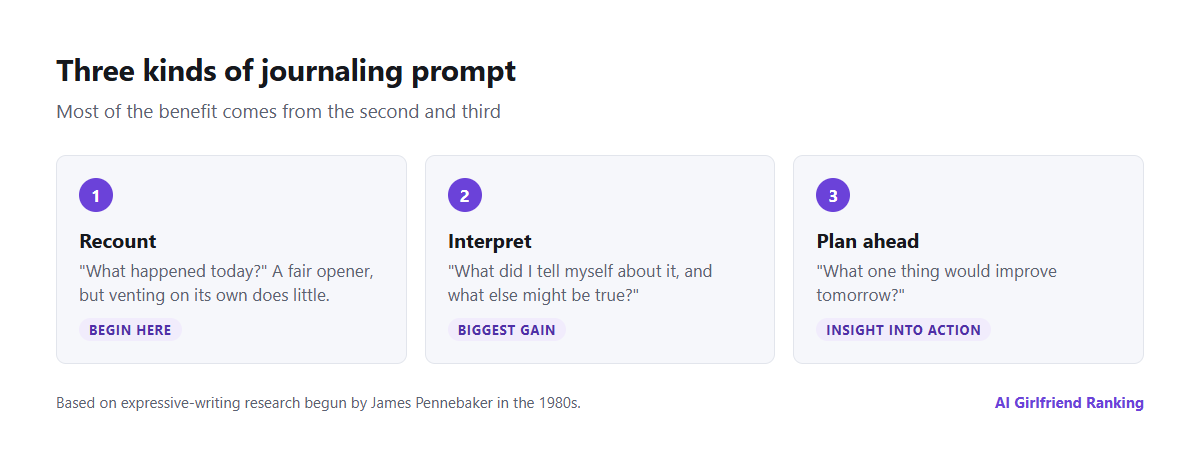
Favour the second and third kinds, which is where most of the benefit lies.
First, set the terms for the evening with a message along these lines:
(OOC: For tonight, be my journaling partner rather than my cheering section. Put one question to me at a time. Do not name my feelings for me or rule on whether I was right. Keep each reply brief.)
After that, pick the prompt that matches your mood:
| Situation | What to ask the AI |
|---|---|
| A bad day | "Question me about what occurred, then about the story I told myself, then about other possible readings." |
| A nagging worry | "Help me separate worries I can do something about this week from ones I cannot." |
| Searching for patterns | "Ask what today had in common with last week, and what was new." |
| Tomorrow's plan | "Ask me to name one change that would help tomorrow, and what could block it." |
| Gratitude with substance | "Have me list three precise good moments and explain what produced each." |
| After a disagreement | "Make me tell it again from the other person's point of view, in their own words." |
A five-minute nightly pattern
- Send the tone message above, or keep it as a note in the character's settings.
- Work through one prompt in complete sentences for three or four minutes.
- Write the final sentence on your own, saying what is clear to you now that was not when you began.
- End the session. Do not drift into an hour of casual talk; the reflection was the purpose, and that chat is a different pastime.
Store delicate things elsewhere
One workable arrangement is to use the app for prompts and structure while a private file or paper notebook holds anything naming other people, describing your health or containing what you would not want a stranger reading. Each week, transfer your one-line takeaways into the private record.
When journaling is not the answer
Writing eases everyday stress and helps you process events. It does not treat depression, trauma or thoughts of self-harm, and an AI is not a counsellor; see an AI companion is not a therapist. If your entries keep returning to hopelessness, talk to a person. In Canada, you can call or text 9-8-8, the Suicide Crisis Helpline, at any time of day, and in an emergency you should call 911. Outside Canada, findahelpline.com lists free services by country.