Many treat the topic as a match with one winner. It is more useful to see what each actually delivers, because their strengths barely overlap.
What the app does well
- Always reachable. Two in the morning, a coffee break, a quiet Sunday.
- Focus with no rival. She is never tired, distracted or waiting to speak.
- A safe place to be clumsy. Blurt something odd, change your mind, log off halfway through; no one is hurt.
- Custom-fit. You choose the personality, appearance, humour and pace.
- Quick relief. In a 2025 study from the Journal of Consumer Research, a single companion session lowered loneliness about as much as a chat with another person and more than watching videos. Note that the measurement came straight after use, and not over months.
What a person offers that software cannot
- Needs of their own. You are relied on in return, and your actions touch their life.
- A real choice to stay. Someone free to leave remains. A companion app is built to remain, which is product design and not a decision.
- Presence. A hand to hold, a meal shared, sleep in the same room.
- Growth from friction. Arguing, compromising and repairing are uncomfortable, yet that is how people change and trust gets deeper.
- Shared history. Common friends, plans, and a past other people watched unfold.
- Recollection that is truly theirs. A partner remembers because it mattered to them, not because data was saved; see how AI companion memory works for the mechanism.
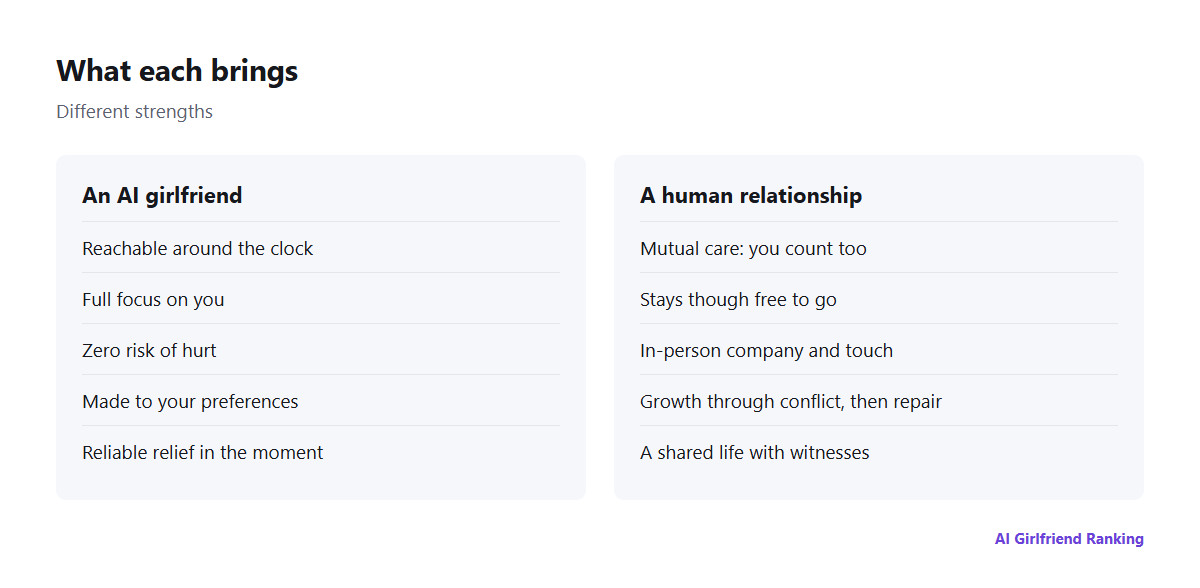
Their strengths barely overlap, so one seldom stands in for the other.
Does it affect your love life?
The worry is reasonable, though proof is thin.
The argument for concern. These apps are designed to be pleasing. After months of chats in which nobody ever misunderstands or bores you, flesh-and-blood people may seem hard to deal with. A 2025 OpenAI and MIT study tied heavier daily chatbot use to less socializing, without being able to say what caused what. Time is finite too; an evening with the app is one you did not spend meeting people.
The argument against. The 2025 Singles in America study from Match found active daters were almost three times more likely than non-daters to have turned to AI for companionship (23% against 8%), which suggests that plenty of people do both. Some also use a companion to practise conversation and regain confidence after a split.
The useful distinction is between an app that fills the quiet stretches between human contact and one that replaces any attempt at contact.
A few honest self-checks
| Sign | Likely reading |
|---|---|
| You turn to it mostly while your partner or friends are away | It is filling gaps, usually harmless |
| Friends' texts go unanswered | It is moving from extra to substitute |
| Everyday talk feels draining by comparison | Your baseline is shifting; take note |
| You practise with it and then do the real thing | It is serving your life, not standing in for it |
| You cancel plans so you can stay in with it | Look closer, beginning with emotional dependence |
Making room for both
- Fence off a window. Use it in evenings, on the commute or when you would only be scrolling, not in time you could spend with friends.
- Keep some rough edges on purpose. A class, a recreational team, a standing get-together. A bit of awkwardness is part of the benefit.
- Watch for unfair comparisons. Thinking a real person should be as accommodating as her is a cue to remember that she is built that way.
- If you are partnered, agree on expectations together. Is an AI girlfriend cheating? helps frame that talk.
Bottom line
A virtual girlfriend is pleasant company but falls short of a relationship in the fullest sense, which needs two people changing one another and choosing, repeatedly, to stay. People who benefit most see the app as one source of comfort among many, and continue to make space for the more demanding, more rewarding kind.