The dilemma looks new, yet its outline is old. Partners have long had to work out where the boundary falls on flirting, porn, intense friendships and chat rooms. An AI girlfriend is one more item on a list that was never finished.
What people report
A US survey gives some sense of scale. Match's Singles in America 2025, conducted with the Kinsey Institute, reported that 16% of American singles had engaged with AI romantically, a share that climbed to about a third among Gen Z. On whether having an AI boyfriend or girlfriend is cheating, 40% of those respondents answered yes.
Forty percent is not a majority, yet it is far from marginal. In one household, one person may shrug while the other winces, and neither is necessarily wrong; they hold different unwritten rules.
Why the answer varies
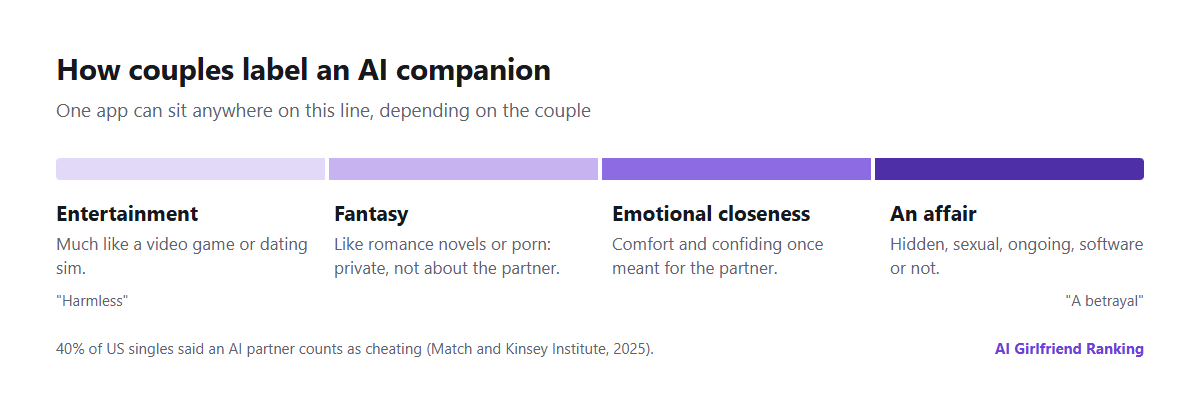
Where a couple puts it depends on what they already consider private, shared or exclusive.
We tend to judge a new thing by the nearest familiar one, so AI companions get sorted like this:
- "It's a game." Characters, scenes and roleplay, about as serious as a dating sim.
- "It's fantasy." Akin to porn or erotic fiction: private, nothing to do with the partner, and tolerable or not according to how the couple already regards those.
- "It's emotional closeness." Once you are confiding, being comforted and looking forward to the next chat, it begins to look like a close bond, and for some people monogamy includes emotional exclusivity.
- "It's an affair." Concealed, sexual and ongoing, with real hours and money going in. To some, knowing the other party is software alters nothing.
What partners typically object to
Day to day, the technology is rarely the problem. The complaint tends to be one of these:
| The grievance | Why it stings | What eases it |
|---|---|---|
| Keeping it hidden | Discovery feels like being lied to, whatever was hidden | Telling them yourself before they find out |
| Time spent | Evenings on the app are evenings apart | Limiting it to hours that are truly your own |
| Emotional sharing | Feelings go to the app in place of the partner | Bringing the big matters to your partner first |
| Sexual material | Reads as a breach if it never came up | Spelling out what the app is used for |
| Spending | Subscriptions and credits mount up and can look secret | Handling it like any shared-budget expense |
Most of these can be fixed without dropping the app. Concealment is the exception, since it makes nearly every other item a matter of broken trust.
The over-the-shoulder test
Put this to yourself: could my partner read my last week of chats over my shoulder without me wincing?
A yes suggests you are inside your own agreement, and the conversation is mostly about informing them. A no means the source of your unease is what needs discussing, whether that is the content, the feelings or the hours.
Starting the conversation
- Pick a calm moment, not the middle of a disagreement or the instant after being found out.
- Describe it concretely. "I use an app where I talk with an AI character, mostly in the evenings, and now and then it turns flirty."
- Explain what it does for you. Stress relief, amusement, curiosity, loneliness while they are away. Candour at this point makes everything afterward easier.
- Find out where their line is, and listen. They may accept the chatting but not the explicit content, or the reverse.
- Settle on something specific. No NSFW, no confiding about the relationship, only while apart, or no limits whatsoever. Couples who write down even one rule tend to argue about it much less later.
Our guide to telling people about your AI companion goes into the conversation in more depth, including what to do if it goes badly.
If your partner is the one using it
Hurt, confusion and even a sense of being compared are all normal. Before deciding what it means, ask what it does for them, since many people use companions for reasons that have little to do with their partner. Then state your own boundary plainly. You are entitled to have one, even if other couples would not.
Where this leaves you
An AI girlfriend is not cheating by definition, and it is not harmless by definition either. It is something new that couples must fit into the agreements they already hold. The ones who manage well are not those with the loosest rules. They are the ones who spoke up before it became a secret.