Nearly every site covering these apps lives on affiliate income. For the wider economics, including why commissions can rank among an app's largest expenses, see how AI companion apps earn their money. Knowing how the arrangement works tells you which parts of a review to lean on and which to set aside.
Where the money comes from
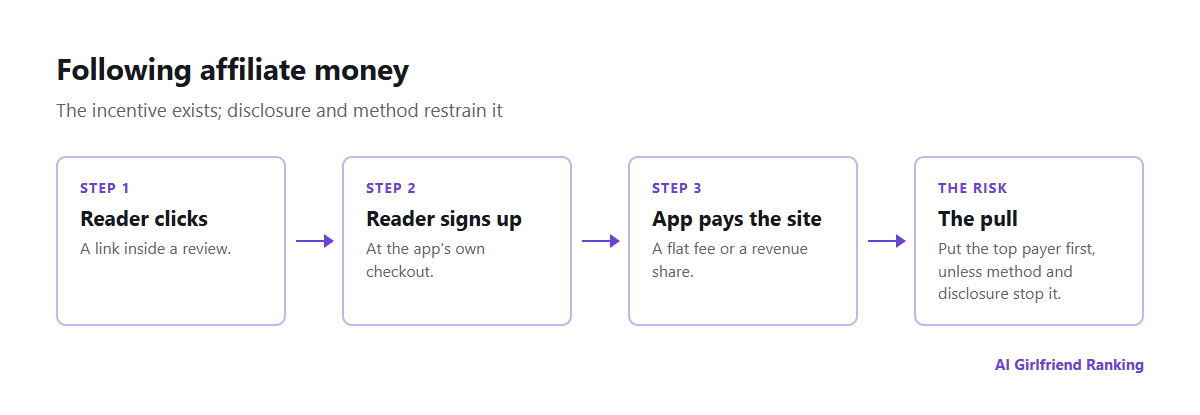
The incentive exists. Disclosure and a published method are what hold it back.
- A reader follows a link from a review site and signs up.
- The app sends the site a one-off fee or a slice of the subscription, sometimes for as long as that reader keeps paying.
- The better an app pays, or the better it converts visitors, the more it is worth to the site.
The pull is obvious: give first place to whoever pays best. Three things resist it: open disclosure, a testing method anyone can read, and the willingness to put a paying app near the bottom when it tests poorly.
What Canadian rules say
In Canada the Competition Act prohibits materially false or misleading representations to the public, and the Competition Bureau says that covers online ratings, reviews and testimonials. The Bureau's guidance on influencer marketing adds that anyone promoting a product should disclose every material connection to it, such as a commission, in plain language, prominently, and not tucked away in a bio or a string of hashtags. Opinions must be honest and based on real experience. The Bureau has also warned businesses about undisclosed reviews written by their own staff, and penalties for misleading marketing can be substantial. Ad Standards' influencer disclosure guidelines point the same way.
A site that hides what it earns is doing more than withholding help; it could be breaking the law.
Clues that a review rests on real testing
| Points to real testing | Points to a rewritten press release |
|---|---|
| Concrete episodes: "by day nine it had recalled..." | Broad statements: "amazing memory" |
| Pricing confirmed on a named date | Figures lifted from the homepage, often outdated |
| Captures of premium features being used | Only publicity images supplied by the app |
| Flaws noted even in the top pick | Every app is "perfect for most users" |
| A method page explaining how scores are set | Bare scores, no reasoning |
| Revisited when the app changes | Left alone for years |
| Mentions privacy incidents linked to the app | Silent on anything unflattering |
Red flags
- One identical podium of three apps, in one order, across many sites. Maybe they really are the best; maybe they pay the best.
- Rankings of apps the site has not reviewed, such as twenty listed and none tested in depth.
- Not a single drawback. Each app in this field involves compromises.
- Ticking timers and "exclusive" offers that never actually expire.
- Near-identical text on different sites, a sign of copy passed around.
Applying the same scrutiny to us
Hold us to the same standard. A disclosure appears on every page. The method, which uses paid accounts, two-week tests, five scores and checks on hidden costs and privacy, is published as our testing approach. Only apps we have tested are ranked, and a few of the ones we link to land near the bottom. If something important emerges after a test, such as a privacy incident, readers are owed a note; one example is the AI companion data breaches roundup.
Even so, do your own checking. No safeguard beats a week of hands-on use, for our reviews as for any other, and a guide to testing an AI girlfriend app yourself lays out how.
Five quick questions
- Is the commission relationship stated next to the recommendation?
- Is there a method page, and does the review stick to it?
- Are there dated specifics that could only come from using the app?
- Does the author criticize the app being recommended?
- Is privacy covered alongside features?
If a review clears all five, read it closely regardless of who wrote it. If it clears none, it is an advertisement, whatever it calls itself.